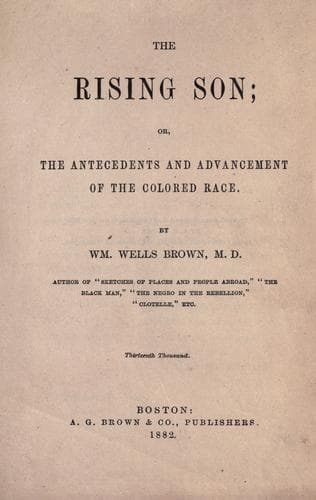
The Rising Son; or, the Antecedents and Advancement of the Colored RaceBrown, William Wells
History
The Rising Son; or, the Antecedents and Advancement of the Colored Race
Brown, William Wells
African Americans -- Biography; African Americans -- History; Black race; Slavery -- United States
“There hath been no company of blacks or slaves brought into the
country since the beginning of this plantation, for the space of fifty
yeares, only one small vessell about two yeares since after twenty
months’ voyage to Madagascar brought hither betwixt forty and fifty
negroes, most women and children, sold for £10, £15, and £20 apiece,
which stood the merchants in near £40 apiece one with another: now and
then two or three negroes are brought hither from Barbadoes and other
of His Majesty’s plantations, and sold here for about £20 apiece, so
that there may bee within our government about one hundred, or one
hundred and twenty, and it may bee as many Scots brought hither and
sold for servants in the time of the war with Scotland, and most now
married and living here, and about halfe so many Irish brought hither
at several times as servants.”
The number of slaves at this period in the middle and southern colonies
is not easily ascertained, as few books, and no newspapers were
published in North America prior to 1704. In that year, the “Weekly
News Letter” was commenced, and in the same year the “Society for the
propagation of the Gospels in foreign parts opened a catechising school
for the slaves at New York, in which city there were then computed
to be about fifteen hundred Negro and Indian slaves,” a sufficient
number to furnish materials for the “irrepressible conflict,” which had
long before begun. The catechist, whom the Society employed, was “Mr.
Elias Neau, by nation a Frenchman, who having made a confession of the
Protestant religion in France, for which he had been confined several
years in prison, and seven years in the galleys.” Mr. Neau entered upon
his office “with great diligence, and his labors were very successful;
but the negroes were much discouraged from embracing the Christian
religion upon the account of the very little regard showed them in any
religious respect. Their marriages were performed by mutual consent
only, without the blessing of the church; they were buried by those
of their own country and complexion, in the common field, without any
Christian office; perhaps some ridiculous heathen rites were performed
at the grave by some of their own people. No notice was given of their
being sick, that they might be visited; on the contrary, frequent
discourses were made in conversation that they had no souls, and
perished as the beasts, and that they grew worse by being taught and
made Christians.”[47]
From this time forward, the increase of slaves was very rapid in
Virginia and South Carolina, and with this increase, discontent began
to show itself amongst the blacks.
FOOTNOTES:
[46] John Josselyn.
[47] Joshua Coffin
CHAPTER XXXII.
COLORED INSURRECTIONS IN THE COLONIES.
Public-domain text, read in full here on John Shaqi.
Reviews
Reviews
No reviews yet
Be the first to share your thoughts on this work.
Elsewhere in the archive
Join the Discussion
Join the discussion
Sign in to leave a comment or review.
Sign InorCreate an account