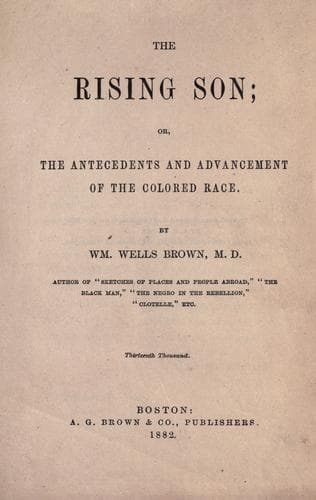
The Rising Son; or, the Antecedents and Advancement of the Colored RaceBrown, William Wells
History
The Rising Son; or, the Antecedents and Advancement of the Colored Race
Brown, William Wells
African Americans -- Biography; African Americans -- History; Black race; Slavery -- United States
The first serious effort at rebellion by the slaves in the colonies,
occurred in New York, in 1712; where, if it had not been for the timely
aid from the garrison, the city would have been reduced to ashes. The
next insurrection took place in South Carolina, in 1720, where the
blacks in considerable numbers attacked the whites in their houses and
in the streets.
Forces were immediately raised and sent after them, twenty-three of
whom were taken, six convicted, three executed, and three escaped.
In October, 1722, about two hundred negroes near the mouth of the
Rappahannock River, Virginia, got together in a body, armed with the
intent to kill the people in church, but were discovered, and fled.
On the 13th of April, 1723, Governor Dummer issued a proclamation with
the following preamble, viz:--
“Whereas, within some short time past, many fires have broke out
within the town of Boston, and divers buildings have thereby been
consumed: which fires have been designedly and industriously kindled
by some villainous and desperate negroes, or other dissolute people,
as appears by the confession of some of them (who have been examined
by the authority), and many concurring circumstances; and it being
vehemently suspected that they have entered into a combination to burn
and destroy the town, I have therefore thought fit, with the advice of
his Majesty’s council, to issue forth this proclamation,” etc.
On the 18th of April, 1723, Rev. Joseph Sewall preached a discourse,
particularly occasioned “by the late fires yt have broke out in Boston,
supposed to be purposely set by ye negroes.”
On the next day, April 19th, the Selectmen of Boston made a report to
the town on the subject, consisting of nineteen articles, of which the
following is No. 9:--
“That if more than two Indians, Negro or Mulatto Servants or Slaves
be found in the Streets or Highways in or about the Town, idling or
lurking together unless in the service of their Master or Employer,
every one so found shall be punished at the House of Correction.”
So great at that time were the alarm and danger in Boston, occasioned
by the slaves, that in addition to the common watch, a military force
was not only kept up, but at the breaking out of every fire, a part of
the militia were ordered out under arms to keep the slaves in order!!
In 1728, an insurrection of slaves occurred in Savannah, Georgia, who
were fired on twice before they fled. They had formed a plot to destroy
all the whites, and nothing prevented them but a disagreement about the
mode. At that time, the population consisted of three thousand whites
and two thousand seven hundred blacks.
In August, 1730, an insurrection of blacks occurred in Williamsburgh,
Virginia, occasioned by a report, on Colonel Spotswood’s arrival, that
he had directions from His Majesty to free all baptized persons. The
negroes improved this to a great height. Five counties were in arms
pursuing them, with orders to kill them if they did not submit.
Public-domain text, read in full here on John Shaqi.
Reviews
Reviews
No reviews yet
Be the first to share your thoughts on this work.
Elsewhere in the archive
Join the Discussion
Join the discussion
Sign in to leave a comment or review.
Sign InorCreate an account