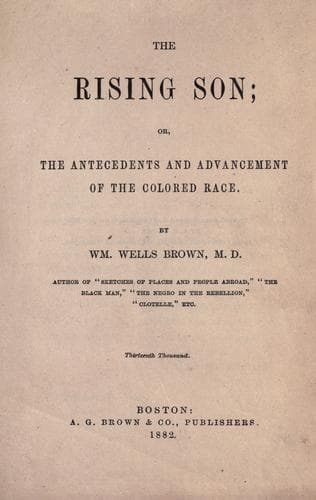
The Rising Son; or, the Antecedents and Advancement of the Colored RaceBrown, William Wells
History
The Rising Son; or, the Antecedents and Advancement of the Colored Race
Brown, William Wells
African Americans -- Biography; African Americans -- History; Black race; Slavery -- United States
“By this time, you have no doubt heard of the conspiracy formed in this
country by the negroes, which, but for the interposition of Providence,
would have put the metropolis of the State, and even the State itself,
into their possession. A dreadful storm, with a deluge of rain, which
carried away the bridges, and rendered the water-courses everywhere
impassable, prevented the execution of their plot. It was extensive
and vast in its design. Nothing could have been better contrived. The
conspirators were to have seized on the magazine, the treasury, the
mills, and the bridges across James River. They were to have entered
the city of Richmond in three places with fire and sword, to commence
an indiscriminate slaughter, the French only excepted. They were then
to have called on their fellow-negroes and the friends of humanity
throughout the continent, by proclamation, to rally round their
standard. The magazine, which was defenceless, would have supplied them
with arms for many thousand men.
“The treasury would have given them money, the mills bread, and the
bridges would have enabled them to let in their friends, and keep
out their enemies. Never was there a more propitious season for the
accomplishment of their purpose.
“The country is covered with rich harvests of Indian corn; flocks and
herds are everywhere fat in the fields, and the liberty and equality
doctrine, nonsensical and wicked as it is (in this land of tyrants and
slaves), is for electioneering purposes sounding and resounding through
our valleys and mountains in every direction. The city of Richmond
and the circumjacent country are in arms, and have been so for ten or
twelve days past. The patrollers are doubled through the State, and the
Governor, impressed with the magnitude of the danger, has appointed for
himself three aids-de-camp. A number of conspirators have been hung,
and a great many more are yet to be hung. The trials and executions are
going on day by day. Poor, deluded wretches! Their democratic deluders,
conscious of their own guilt, and fearful of the public vengeance, are
most active in bringing them to punishment.”
CHAPTER XXXIII.
BLACK MEN IN THE REVOLUTIONARY WAR.
The Boston Massacre, March 5, 1770, may be regarded as the first act in
the great drama of the American Revolution. “From that moment,” said
Daniel Webster, “we may date the severance of the British Empire.” The
presence of the British soldiers in King Street excited the patriotic
indignation of the people. The whole community was stirred, and sage
counsellors were deliberating and writing and talking about the public
grievances. But it was not for “the wise and prudent” to be the first
to act against the encroachments of arbitrary power.
Public-domain text, read in full here on John Shaqi.
Reviews
Reviews
No reviews yet
Be the first to share your thoughts on this work.
Elsewhere in the archive
Join the Discussion
Join the discussion
Sign in to leave a comment or review.
Sign InorCreate an account