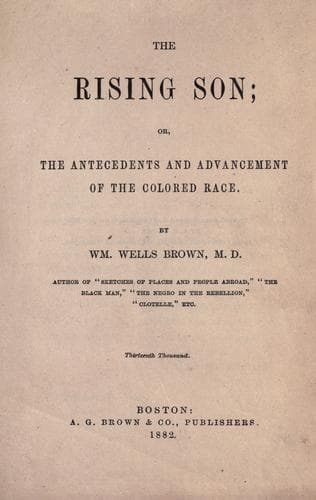
The Rising Son; or, the Antecedents and Advancement of the Colored RaceBrown, William Wells
History
The Rising Son; or, the Antecedents and Advancement of the Colored Race
Brown, William Wells
African Americans -- Biography; African Americans -- History; Black race; Slavery -- United States
A motley rabble of men and boys, led by Crispus Attucks, a negro, and
shouting, “The way to get rid of these soldiers is to attack the main
guard; strike at the root; this is the nest!” with more valor than
discretion, they rushed to King Street, and were fired upon by Captain
Preston’s company. Crispus Attucks was the first to fall; he and Samuel
Gray and Jonas Caldwell were killed on the spot. Samuel Maverick and
Patrick Carr were mortally wounded.
The excitement which followed was intense. The bells of the town
were rung; an impromptu meeting was held, and an immense assembly was
gathered. Three days after, on the 8th, a public funeral of the martyrs
took place. The shops in Boston were closed; all the bells of Boston
and neighboring towns were rung. It was said that a greater number of
persons assembled on this occasion than were ever before gathered on
the continent for a similar purpose.
The body of Attucks, the negro slave, had been placed in Faneuil Hall,
with that of Caldwell, both being strangers in the city. Maverick was
buried from his mother’s house in Union Street, and Gray from his
brother’s, in Royal Exchange Lane. The four hearses formed a junction
in King Street, and there the procession marched on in columns six
deep, with a long file of coaches belonging to the most distinguished
citizens, to the middle burying-ground, where the four victims were
deposited in one grave, over which a stone was placed with the
following inscription:
“Long as in Freedom’s cause the wise contend,
Dear to your country shall your fame extend;
While to the world the lettered stone shall tell,
Where Caldwell, Attucks, Gray and Maverick fell.”
The anniversary of this event was publicly commemorated in Boston, by
an oration and other exercises, every year until after our national
independence was achieved, when the Fourth of July was substituted for
the fifth of March, as the more proper day for general celebration. Not
only was the occasion commemorated, but the martyrs who then gave up
their lives were remembered and honored. For half a century after the
close of the war, the name of Crispus Attucks was honorably mentioned
by the most noted men of the country, who were not blinded by foolish
prejudice, which, to say the most, was only skin-deep.
A single passage from Bancroft’s history will give a succinct and clear
account of the condition of the army in respect to colored soldiers, at
the time of the battle of Bunker Hill:--
Public-domain text, read in full here on John Shaqi.
Reviews
Reviews
No reviews yet
Be the first to share your thoughts on this work.
Elsewhere in the archive
Join the Discussion
Join the discussion
Sign in to leave a comment or review.
Sign InorCreate an account