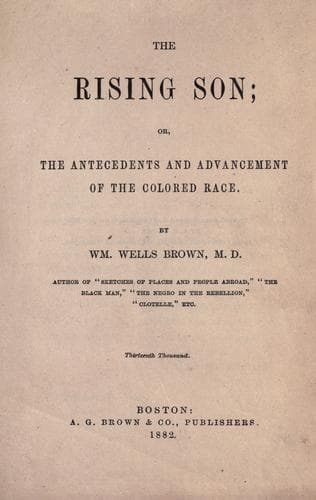
The Rising Son; or, the Antecedents and Advancement of the Colored RaceBrown, William Wells
History
The Rising Son; or, the Antecedents and Advancement of the Colored Race
Brown, William Wells
African Americans -- Biography; African Americans -- History; Black race; Slavery -- United States
“Nor should history forget to record, that, as in the army at
Cambridge, so also in this gallant band, the free negroes of the colony
had their representatives. For the right of free negroes to bear arms
in the public defence was, at that day, as little disputed in New
England as their other rights. They took their place not in a separate
corps, but in the ranks with the white man; and their names may be read
on the pension-rolls of the country, side by side with those of other
soldiers of the Revolution.”[48]
The capture of Major-General Prescott, of the British army, on the
9th of July, 1777, was an occasion of great rejoicing throughout the
country. Prince, the valiant negro who seized that officer, ought
always to be remembered with honor for his important service.
The battle of Red Bank, and the battle of Rhode Island, on the 29th of
August, 1778, entitle the blacks to perpetual honor.[49]
When Colonel Green was surprised and murdered, near Points Bridge, New
York, on 14th of May, 1781, his colored soldiers heroically defended
him till they were cut to pieces; and the enemy reached him over the
dead bodies of his faithful negroes. Of this last engagement, Arnold,
in his “History of Rhode Island,” says:--
“A third time the enemy, with desperate courage and increased strength,
attempted to assail the redoubt and would have carried it, but for the
timely aid of two continental battalions despatched by Sullivan to
support his almost exhausted troops. It was in repelling these furious
onsets, that the newly raised black regiment, under Colonel Greene,
distinguished itself by deeds of desperate valor. Posted behind a
thicket in the valley, they three times drove back the Hessians, who
charged repeatedly down the hill to dislodge them; and so determined
were the enemy in these successive charges, that, the day after the
battle, the Hessian colonel, upon whom this duty had devolved, applied
to exchange his command, and go to New York, because he dared not lead
his regiment again to battle, lest his men should shoot him for having
caused them so much loss.”
FOOTNOTES:
[48] Bancroft’s “History of the United States.” Vol. VII. p. 421.
[49] Moore’s “Diary of the American Revolution.” Vol. I. p. 468.
CHAPTER XXXIV.
BLACKS IN THE WAR OF 1812.
In the war of 1812, colored men again did themselves honor by
volunteering their services in aid of American freedom, both at
the North and at the South. In the latter section, even the slaves
were invited, and entered the army, where their bravery was highly
appreciated. The following document speaks for itself.
“HEAD QUARTERS, SEVENTH MILITARY DISTRICT, }
MOBILE, September 21, 1814. }
“_To the Free Colored Inhabitants of Louisiana_:
“Through a mistaken policy, you have heretofore been deprived of
a participation in the glorious struggle for national rights, in
which our country is engaged. This no longer shall exist.
Public-domain text, read in full here on John Shaqi.
Reviews
Reviews
No reviews yet
Be the first to share your thoughts on this work.
Elsewhere in the archive
Join the Discussion
Join the discussion
Sign in to leave a comment or review.
Sign InorCreate an account