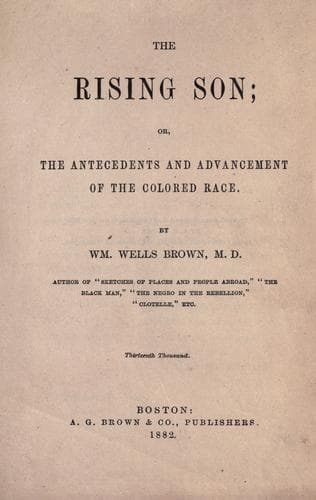
The Rising Son; or, the Antecedents and Advancement of the Colored RaceBrown, William Wells
History
The Rising Son; or, the Antecedents and Advancement of the Colored Race
Brown, William Wells
African Americans -- Biography; African Americans -- History; Black race; Slavery -- United States
For each day employed in hunting or trailing $2.50
For catching each slave 10.00
For going over ten miles, and catching slaves 20.00
“If sent for, the above prices will be exacted in cash. The
subscriber resides one mile and a half south of Dadeville, Ala.
“B. BLACK.”
Slavery so completely seared the conscience of the whites of the South,
that they had no feeling of compassion for the blacks, as the following
illustration will show. At St. Louis, in the year 1835, Francis
McIntosh, a free colored man, while defending himself from an attack of
white ruffians, one of the latter was killed. At once the colored man
was taken, chained to a tree, and burnt to death. One of the newspapers
at the time gave the following account of the inhuman affair:--
“All was silent as death while the executioners were piling wood around
their victim. He said not a word, until feeling that the flames had
seized upon him. He then uttered an awful howl, attempting to sing
and pray, then hung his head, and suffered in silence, except in
the following instance. After the flames had surrounded their prey,
his eyes burnt out of his head, and his mouth seemingly parched to
a cinder, some one in the crowd, more compassionate than the rest,
proposed to put an end to his misery by shooting him, when it was
replied, ‘That would be of no use, since he was already out of pain.’
‘No, no,’ said the wretch, ‘I am not, I am suffering as much as ever;
shoot me, shoot me.’ ‘No, no,’ said one of the fiends who was standing
about the sacrifice they were roasting, ‘he shall not be shot. I would
sooner slacken the fire, if it would increase his misery;’ and the man
who said this was, as we understand, an officer of justice!”
Lest this demonstration of “public opinion” should be regarded as a
sudden impulse merely, not an index of the settled tone of feeling in
that community, it is important to add, that the Hon. Luke E. Lawless,
Judge of the Circuit Court of Missouri, at a session of that court
in the city of St. Louis, some months after the burning of this man,
decided officially that since the burning of McIntosh was the act,
either directly or by countenance of a majority of the citizens, it
is “a case which transcends the jurisdiction” of the Grand Jury! Thus
the State of Missouri proclaimed to the world that the wretches who
perpetrated that unspeakably diabolical murder, and the thousands that
stood by consenting to it, were her representatives, and the Bench
sanctified it with the solemnity of a judicial decision.
CHAPTER XXXVI.
DISCONTENT AND INSURRECTION.
Public-domain text, read in full here on John Shaqi.
Reviews
Reviews
No reviews yet
Be the first to share your thoughts on this work.
Elsewhere in the archive
Join the Discussion
Join the discussion
Sign in to leave a comment or review.
Sign InorCreate an account