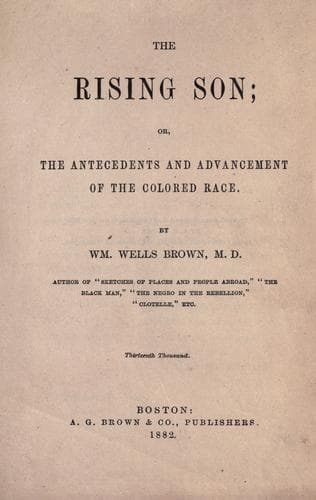
The Rising Son; or, the Antecedents and Advancement of the Colored RaceBrown, William Wells
History
The Rising Son; or, the Antecedents and Advancement of the Colored Race
Brown, William Wells
African Americans -- Biography; African Americans -- History; Black race; Slavery -- United States
An undeveloped discontent always pervaded the black population of the
South, bond and free. Human bondage is ever fruitful of insurrection,
wherever it exists, and under whatever circumstances it may be found.
The laws forbidding either free people of color or slaves to assemble
in any considerable numbers for religious, or any other purpose,
without two or more whites being present, and the rigorous enforcement
of such laws, show how fearful the slave-masters were of their injured
victims.
Everything was done to make the Negro feel that he was not a man, but
a thing; his inferiority was impressed upon him in all possible ways.
In the great cities of the South, free colored ladies were not allowed
to wear a veil in the streets, or in any public places. A violation of
this law was visited with thirty-nine lashes upon the bare back. The
same was inflicted upon the free colored man who should be seen upon
the streets with a cigar in his mouth, or a walking-stick in his hand.
Both, when walking the streets, were forbidden to take the inside of
the pavement. Punishment of fine and imprisonment was laid upon any
found out of their houses after nine o’clock at night.
An extra tax was placed upon every member of a free colored family.
While all these odious edicts were silently borne by the free colored
people of Charleston, South Carolina, in 1822, there was a suppressed
feeling of indignation, mortification, and discontent, that was only
appreciated by a few. Among the most dissatisfied of the free blacks
was Denmark Vesey, a man who had purchased his freedom in the year
1800, and since that time had earned his living by his trade, being a
carpenter and joiner.
In person, Vesey was tall and of spare make; in color, a dark mulatto;
high forehead; eyes, dark brown; nose, long and with a Roman cast. His
education was superior to that of his associates, and he had read much,
especially of the condition of his own race, and felt deeply for them
in their degraded condition.
Vesey was a native of the West Indies. Having been employed on
shipboard by his master, Captain Vesey, Denmark had seen a great
deal of the world, and had acquired a large fund of information, and
was regarded as a leading man among the blacks. He had studied the
Scriptures, and never lost an opportunity of showing that they were
opposed to chattel-slavery. He spoke freely with the slaves upon the
subject, and often with the whites, where he found he could do so
without risk to his own liberty.
After resolving to incite the slaves to rebellion, he began taking
into his confidence such persons as he could trust, and instructing
them to gain adherents from among the more reliable of both bond and
free. Peter Poyas, a slave of more than ordinary foresight and ability,
was selected by Vesey as his lieutenant; and to him was committed the
arduous duty of arranging the mode of attack, and of acting as the
military leader.
Public-domain text, read in full here on John Shaqi.
Reviews
Reviews
No reviews yet
Be the first to share your thoughts on this work.
Elsewhere in the archive
Join the Discussion
Join the discussion
Sign in to leave a comment or review.
Sign InorCreate an account