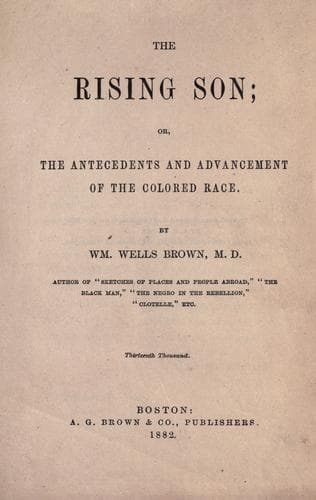
The Rising Son; or, the Antecedents and Advancement of the Colored RaceBrown, William Wells
History
The Rising Son; or, the Antecedents and Advancement of the Colored Race
Brown, William Wells
African Americans -- Biography; African Americans -- History; Black race; Slavery -- United States
A fifth, composed of country and Neck negroes, was to assemble at
Bulkley’s farm, two miles and a half from the city, seize the upper
powder magazine, and then march down; and a sixth was to assemble at
Denmark Vesey’s, and obey his orders. A seventh detachment, under
Gullah Jack, was to assemble in Boundary Street, at the head of King
Street, to capture the arms of the Neck company of militia, and to
take an additional supply from Mr. Duquercron’s shop. The naval stores
on Mey’s Wharf were also to be attacked. Meanwhile a horse company,
consisting of many draymen, hostlers, and butcher boys, was to meet at
Lightwood’s Alley, and then scour the streets to prevent the whites
from assembling. Every white man coming out of his own door was to
be killed, and, if necessary, the city was to be fired in several
places--slow match for this purpose having been purloined from the
public arsenal and placed in an accessible position.
The secret and plan of attack, however, were incautiously divulged
to a slave named Devany, belonging to Colonel Prioleau, and he at
once informed his master’s family. The mayor, on getting possession
of the facts, called the city council together for consultation. The
investigation elicited nothing new, for the slaves persisted in their
ignorance of the matter, and the authorities began to feel that they
had been imposed upon by Devany and his informant, when another of
the conspirators, being bribed, revealed what he knew. Arrests after
arrests were made, and the Mayor’s Court held daily examinations for
weeks. After several weeks of incarceration, the accused, one hundred
and twenty in number, were brought to trial: thirty-four were sentenced
to transportation, twenty-seven acquitted by the court, twenty-five
discharged without trial, and thirty-five condemned to death. With but
two or three exceptions, all of the conspirators went to the gallows
feeling that they had acted right, and died like men giving their lives
for the cause of freedom. A report of the trial, written soon after,
says of Denmark Vesey:--
“For several years before he disclosed his intentions to any one, he
appears to have been constantly and assiduously engaged in endeavoring
to embitter the minds of the colored population against the white.
He rendered himself perfectly familiar with all those parts of the
Scriptures which he thought he could pervert to his purpose, and would
readily quote them to prove that slavery was contrary to the laws of
God,--that slaves were bound to attempt their emancipation, however
shocking and bloody might be the consequences,--and that such efforts
would not only be pleasing to the Almighty, but were absolutely
enjoined, and their success predicted, in the Scriptures. His favorite
texts, when he addressed those of his own color, were Zachariah xiv:
1-3, and Joshua vi: 21; and in all his conversations he identified
their situation with that of the Israelites.
Public-domain text, read in full here on John Shaqi.
Reviews
Reviews
No reviews yet
Be the first to share your thoughts on this work.
Elsewhere in the archive
Join the Discussion
Join the discussion
Sign in to leave a comment or review.
Sign InorCreate an account