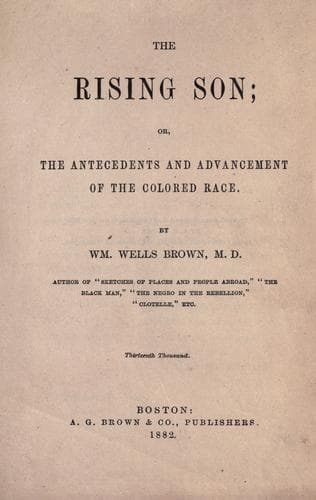
The Rising Son; or, the Antecedents and Advancement of the Colored RaceBrown, William Wells
History
The Rising Son; or, the Antecedents and Advancement of the Colored Race
Brown, William Wells
African Americans -- Biography; African Americans -- History; Black race; Slavery -- United States
His plans showed some natural generalship; he arranged the night
attack; he planned the enrollment of a mounted troop to scour the
streets; and he had a list of all the shops where arms and ammunition
were kept for sale. He voluntarily undertook the management of the
most difficult part of the enterprise,--the capture of the main
guard-house,--and had pledged himself to advance alone, and surprise
the sentinel. He was said to have a magnetism in his eye, of which his
confederates stood in great awe; if he once got his eye upon a man,
there was no resisting it.
Gullah Jack, Tom Russell, and Ned Bennett. The last two were not less
valuable than Peter Poyas; for Tom was an ingenious mechanic, and made
battle-axes, pikes, and other instruments of death, with which to carry
on the war. All of the above were to be generals of brigades, and were
let into all the secrets of the intended rising. It has long been
the custom in Charleston for the country slaves to visit the city in
great numbers on Sunday, and return to their homes in time to commence
work on the following morning. It was therefore determined by Denmark
to have the rising take place on Sunday. The slaves of nearly every
plantation in the vicinity were enlisted, and were to take part.
The details of the plan, however, were not rashly committed to the
mass of the confederates; they were known only to a few, and were
finally to have been announced after the evening prayer-meeting on
the appointed Sunday. But each leader had his own company enlisted,
and his own work marked out. When the clock struck twelve, all were
to move. Peter Poyas was to lead a party ordered to assemble at South
Bay, and to be joined by a force from James’ Island; he was then to
march up and seize the arsenal and guard-house opposite St. Michael’s
Church, and detach a sufficient number to cut off all white citizens
who should appear at the alarm posts. A second body of negroes, from
the country and the Neck, headed by Ned Bennett, was to assemble on
the Neck and seize the arsenal there. A third was to meet at Governor
Bennett’s Mills, under command of Rolla, another leader, and, after
putting the governor and intendant to death, to march through the
city, or be posted at Cannon’s Bridge, thus preventing the inhabitants
of Cannonsborough from entering the city. A fourth, partly from the
country and partly from the neighboring localities in the city, was to
rendezvous on Gadsden’s Wharf, and attack the upper guard-house.
Public-domain text, read in full here on John Shaqi.
Reviews
Reviews
No reviews yet
Be the first to share your thoughts on this work.
Elsewhere in the archive
Join the Discussion
Join the discussion
Sign in to leave a comment or review.
Sign InorCreate an account