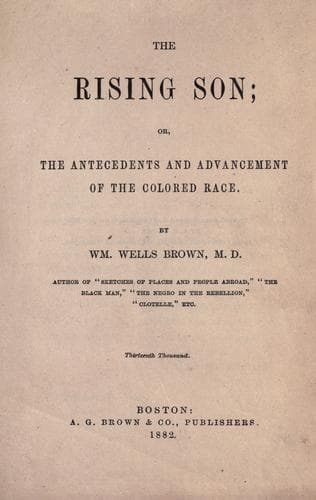
The Rising Son; or, the Antecedents and Advancement of the Colored RaceBrown, William Wells
History
The Rising Son; or, the Antecedents and Advancement of the Colored Race
Brown, William Wells
African Americans -- Biography; African Americans -- History; Black race; Slavery -- United States
The excitement which the revelations of the trial occasioned, and
the continual fanning of the flame by the newspapers, were beyond
description. Double guard in the city, the country patrol on
horseback and on foot, the watchfulness that was observed on all
plantations, showed the deep feeling of fear pervading the hearts of
the slaveholders, not only in South Carolina, but the fever extended
to the other Southern states, and all seemed to feel that a great
crisis had been passed. And indeed, their fears seem not to have been
without ground, for a more complicated plan for an insurrection could
scarcely have been conceived. And many were of opinion that the rising
once begun, they would have taken the city and held it, and might have
sealed the fate of slavery in the South.[51] But a more successful
effort in rebellion was made in Southampton, Virginia, in the year
1831, at the head of which was Nat Turner.
On one of the oldest and largest plantations in Southampton County,
Virginia, owned by Benjamin Turner, Esq., Nat was born a slave, on
the 2d of October, 1800. His parents were of unmixed African descent.
Surrounded as he was by the superstition of the slave quarters, and
being taught by his mother that he was born for a prophet, a preacher,
and a deliverer of his race, it is not strange that the child should
have imbibed the principles which were afterwards developed in his
career. Early impressed with the belief that he had seen visions, and
received communications direct from God, he, like Napoleon, regarded
himself as a being of destiny. In his childhood Nat was of an amiable
disposition; but circumstances in which he was placed as a slave,
brought out incidents that created a change in his disposition, and
turned his kind and docile feeling into the most intense hatred to the
white race.
Being absent one night from his master’s plantation without a pass,
he was caught by Whitlock and Mull, the two district patrolers, and
severely flogged. This act of cruelty inflamed the young slave, and he
resolved upon having revenge. Getting two of the boys of a neighboring
plantation to join him, Nat obtained a long rope, went out at night
on the road through which the officers had their beat, and stationing
his companions, one on each side of the road, he stretched the rope
across, fastening each end to a tree, and drawing it tight. His rope
thus fixed, and his accomplices instructed how to act their part, Nat
started off up the road. The night being dark, and the rope only six or
eight inches from the ground, the slave felt sure that he would give
his enemies a “high fall.”
Public-domain text, read in full here on John Shaqi.
Reviews
Reviews
No reviews yet
Be the first to share your thoughts on this work.
Elsewhere in the archive
Join the Discussion
Join the discussion
Sign in to leave a comment or review.
Sign InorCreate an account