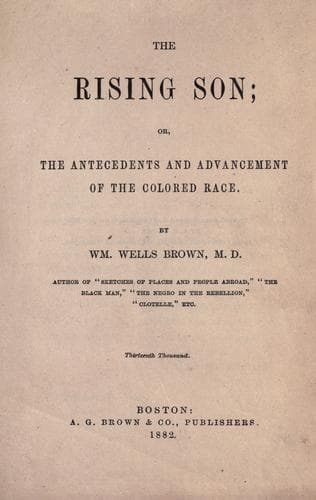
The Rising Son; or, the Antecedents and Advancement of the Colored RaceBrown, William Wells
History
The Rising Son; or, the Antecedents and Advancement of the Colored Race
Brown, William Wells
African Americans -- Biography; African Americans -- History; Black race; Slavery -- United States
Nat hearing them, he called out in a disguised voice, “Is dat you,
Jim?” To this Whitlock replied, “Yes, dis is me.” Waiting until the
white men were near him, Nat started off upon a run, followed by the
officers. The boy had placed a sheet of white paper in the road, so
that he might know at what point to jump the rope, so as not to be
caught in his own trap. Arriving at the signal he sprung over the
rope, and went down the road like an antelope. But not so with the
white men, for both were caught by the legs and thrown so hard upon
the ground that Mull had his shoulder put out of joint, and his face
terribly lacerated by the fall; while Whitlock’s left wrist was
broken, and his head bruised in a shocking manner. Nat hastened home,
while his companions did the same, not forgetting to take with them
the clothesline which had been so serviceable in the conflict. The
patrolers were left on the field of battle, crying, swearing, and
calling for help.
Snow seldom falls as far south as the southern part of Virginia; but
when it does, the boys usually have a good time snow-balling, and on
such occasions the slaves, old and young, women and men, are generally
pelted without mercy, and with no right to retaliate. It was only a
few months after his affair with the patrolers, that Nat was attacked
by a gang of boys, who chased him some distance, snow-balling with all
their power. The slave boy knew the lads, and determined upon revenge.
Waiting till night, he filled his pockets with rocks, and went into
the street. Very soon the same gang of boys were at his heels, and
pelting him. Concealing his face so as not to be known, Nat discharged
his rocks in every direction, until his enemies had all taken to their
heels.
The ill treatment he experienced at the hands of the whites, and the
visions he claimed to have seen, caused Nat to avoid, as far as he
could, all intercourse with his fellow-slaves, and threw around him a
gloom and melancholy that disappeared only with his life.
Both the young slave and his friends averred that a full knowledge of
the alphabet came to him in a single night. Impressed with the belief
that his mission was a religious one, and this impression strengthened
by the advice of his grandmother, a pious but ignorant woman, Nat
commenced preaching when about twenty-five years of age, but never
went beyond his own master’s locality. In stature he was under the
middle size, long-armed, round-shouldered, and strongly marked with
the African features. A gloomy fire burned in his looks, and he had a
melancholy expression of countenance. He never tasted a drop of ardent
spirits in his life, and was never known to smile. In the year 1828 new
visions appeared to Nat, and he claimed to have direct communication
with God. Unlike most of those born under the influence of slavery, he
had no faith in conjuring, fortune-telling, or dreams, and always spoke
with contempt of such things.
Public-domain text, read in full here on John Shaqi.
Reviews
Reviews
No reviews yet
Be the first to share your thoughts on this work.
Elsewhere in the archive
Join the Discussion
Join the discussion
Sign in to leave a comment or review.
Sign InorCreate an account