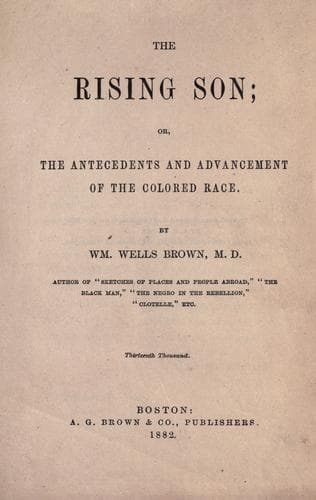
The Rising Son; or, the Antecedents and Advancement of the Colored RaceBrown, William Wells
History
The Rising Son; or, the Antecedents and Advancement of the Colored Race
Brown, William Wells
African Americans -- Biography; African Americans -- History; Black race; Slavery -- United States
Being hired out to cruel masters, he ran away and remained in the woods
thirty days, and could have easily escaped to the free states, as
did his father some years before; but he received, as he says in his
confession a communication from the spirit, which said, “Return to your
earthly master, for he who knoweth his Master’s will, and doeth it not,
shall be beaten with many stripes.” It was not the will of his earthly,
but his heavenly Master that he felt bound to do, and therefore Nat
returned. His fellow-slaves were greatly incensed at him for coming
back, for they knew well his ability to reach Canada, or some other
land of freedom, if he was so inclined.
He says further: “About this time I had a vision, and saw white spirits
and black spirits engaged in battle, and the sun was darkened, the
thunder rolled in the heavens, and blood flowed in streams; and I heard
a voice saying, ‘Such is your luck; such are you called on to see; and
let it come, rough or smooth, you must surely bear it.’”
Some time after this, Nat had, as he says, another vision, in which
the spirit appeared and said, “The serpent is loosened, and Christ has
laid down the yoke he has borne for the sins of men, and you must take
it up, and fight against the serpent, for the time is fast approaching
when the first shall be last, and the last shall be first.” There is no
doubt but that this last sentence filled Nat with enthusiastic feeling
in favor of the liberty of his race, that he had so long dreamed of.
“The last shall be first, and the first shall be last,” seemed to him
to mean something. He saw in it the overthrow of the whites, and the
establishing of the blacks in their stead, and to this end he bent
the energies of his mind. In February, 1831, Nat received his last
communication, and beheld his last vision. He said, “I was told I
should arise and prepare myself, and slay my enemies with their own
weapons.”
The plan of an insurrection was now formed in his own mind, and the
time had arrived for him to take others into the secret; and he at once
communicated his ideas to four of his friends, in whom he had implicit
confidence. Hark Travis, Nelson Williams, Sam Edwards, and Henry Porter
were slaves like himself, and like him had taken their names from their
masters. A meeting must be held with these, and it must take place in
some secluded place, where the whites would not disturb them; and a
meeting was appointed. The spot where they assembled was as wild and
romantic as were the visions that had been impressed upon the mind of
their leader.
Public-domain text, read in full here on John Shaqi.
Reviews
Reviews
No reviews yet
Be the first to share your thoughts on this work.
Elsewhere in the archive
Join the Discussion
Join the discussion
Sign in to leave a comment or review.
Sign InorCreate an account