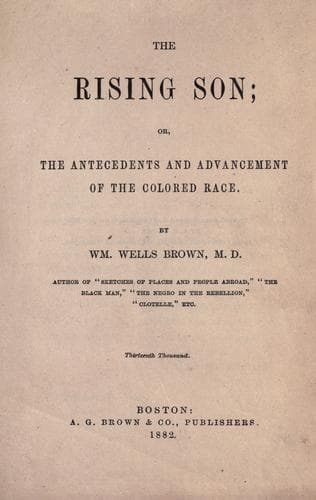
The Rising Son; or, the Antecedents and Advancement of the Colored RaceBrown, William Wells
History
The Rising Son; or, the Antecedents and Advancement of the Colored Race
Brown, William Wells
African Americans -- Biography; African Americans -- History; Black race; Slavery -- United States
“He is a complete fanatic, or plays his part most admirably. On other
subjects he possesses an uncommon share of intelligence, with a
mind capable of attaining anything, but warped and perverted by the
influence of early impressions. He is below the ordinary stature,
though strong and active, having the true negro face, every feature of
which is strongly marked. I shall not attempt to describe the effect of
his narrative, as told and commented on by himself, in the condemned
hole of the prison; the calm, deliberate composure with which he spoke
of his late deeds and intentions; the expression of his fiend-like
face, when excited by enthusiasm--still bearing the stains of the blood
of helpless innocence about him, clothed with rags and covered with
chains, yet daring to raise his manacled hands to Heaven, with a spirit
soaring above the attributes of man; I looked on him, and the blood
curdled in my veins.”
Fifty-five whites and seventy-three blacks lost their lives in the
Southampton rebellion. On the fatal night when Nat and his companions
were dealing death to all they found, Captain Harris, a wealthy
planter had his life saved by the devotion and timely warning of his
slave Jim, said to have been half-brother to his master. After the
revolt had been put down, and parties of whites were out hunting the
suspected blacks, Captain Harris, with his faithful slave, went into
the woods in search of the negroes. In saving his master’s life, Jim
felt that he had done his duty, and could not consent to become a
betrayer of his race; and on reaching the woods, he handed his pistol
to his master, and said, “I cannot help you hunt down these men; they,
like myself, want to be free. Sir, I am tired of the life of a slave;
please give me my freedom, or shoot me on the spot.” Captain Harris
took the weapon and pointed it at the slave. Jim, putting his right
hand upon his heart, said, “This is the spot; aim here.” The captain
fired, and the slave fell dead at his feet.
FOOTNOTE:
[51] T. W. Higginson, in Atlantic Monthly, June, 1861.
CHAPTER XXXVII.
GROWING OPPOSITION TO SLAVERY.
The vast increase of the slave population in the Southern States, and
their frequent insurrectionary efforts, together with the fact that the
whole system was in direct contradiction to the sentiments expressed in
the declaration of American independence, was fast creating a hatred to
slavery.
The society of Friends, the first to raise a warning voice against the
sin of human bondage, had nobly done its duty; and as early as 1789 had
petitioned Congress in favor of the abolition of slavery.
Previous to this, however, William Beorling, a Quaker, of Long Island,
Ralph Sandiford of Philadelphia, Benjamin Lay, and several others of
the society of Friends, had written brave words in behalf of negro
freedom.
Public-domain text, read in full here on John Shaqi.
Reviews
Reviews
No reviews yet
Be the first to share your thoughts on this work.
Elsewhere in the archive
Join the Discussion
Join the discussion
Sign in to leave a comment or review.
Sign InorCreate an account