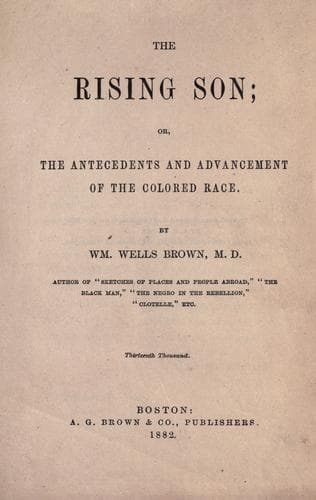
The Rising Son; or, the Antecedents and Advancement of the Colored RaceBrown, William Wells
History
The Rising Son; or, the Antecedents and Advancement of the Colored Race
Brown, William Wells
African Americans -- Biography; African Americans -- History; Black race; Slavery -- United States
Benjamin Lundy, also a member of the Society of Friends, commenced, in
1821, at Baltimore, the publication of a monthly paper, called “The
Genius of Universal Emancipation.” This journal advocated gradual, not
immediate emancipation. It had, however, one good effect, and that was,
to attract the attention of William Lloyd Garrison to the condition of
the enslaved negro.
Out of this interest grew “The Liberator,” which was commenced January
1, 1831, at Boston. Two years later, the American Anti-slavery Society
was organized at Philadelphia.
After setting forth the causes which the patriots of the American
Revolution had to induce them to throw off the British yoke, they nobly
put forth the claim of the slave to his liberty.
The document was signed by sixty-four persons, among whom was William
Lloyd Garrison, and John G. Whittier.
The formation of the American Anti-slavery Society created considerable
excitement at the time, and exposed its authors to the condemnation
of the servile pulpit and press of that period. Few, however, saw the
great importance of such a work, and none of the movers in it imagined
that they would live to witness the accomplishing of an object for
which the society was brought into being.
One of the most malignant opposers that the abolitionists had to meet,
in their commencement, was the American Colonization Society, an
organization which began in 1817, in the interest of the slaveholders,
and whose purpose was to carry off to Africa the free colored people.
Garrison’s “Thoughts on African Colonization,” published in 1832, had
already drawn the teeth of this enemy of the Negro, and for which the
society turned all its batteries against him.
The people of the Southern States were not alone in the agitation, for
the question had found its way into all of the ramifications of society
in the North.
Miss Prudence Crandall, about this time, started a school for colored
females, in Canterbury, Connecticut, which was soon broken up, and Miss
Crandall thrown into prison.
David Walker, a colored man, residing at Boston, had published an
appeal in behalf of his race, filled with enthusiasm, and well
calculated to arouse the ire of the pro-slavery feeling of the country.
The liberation of his slaves, by James G. Binney of Kentucky, and his
letters to the churches, furnished fuel to the agitating flames.
The free colored people of the North, especially in Boston, New York,
and Philadelphia, were alive to their own interest, and were yearly
holding conventions, at which they would recount their grievances, and
press their claims to equal rights with their white fellow-citizens.
At these meetings, the talent exhibited, the able speeches made, and
the strong appeals for justice which were sent forth, did very much to
raise the blacks in the estimation of the whites generally, and gained
for the Negroes’ cause additional friends.
CHAPTER XXXVIII.
MOB LAW TRIUMPHANT.
Public-domain text, read in full here on John Shaqi.
Reviews
Reviews
No reviews yet
Be the first to share your thoughts on this work.
Elsewhere in the archive
Join the Discussion
Join the discussion
Sign in to leave a comment or review.
Sign InorCreate an account