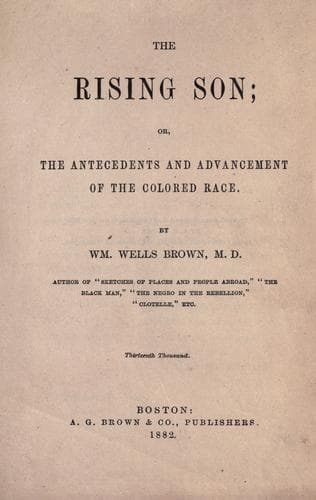
The Rising Son; or, the Antecedents and Advancement of the Colored RaceBrown, William Wells
History
The Rising Son; or, the Antecedents and Advancement of the Colored Race
Brown, William Wells
African Americans -- Biography; African Americans -- History; Black race; Slavery -- United States
In the year 1834, mob law was inaugurated in the free states, which
extended into the years 1835-6 and 7.
The mobbing of the friends of freedom commenced in Boston, in October,
1835, with an attack upon William Lloyd Garrison, and the ladies’
Anti-slavery Society. This mob, made up as it was by “Gentlemen of
property and standing,” and from whom Mr. Garrison had to be taken to
prison to save his life, has become disgracefully historical.
The Boston mob was followed by one at Utica, New York, headed by Judge
Beardsley, who broke up a meeting of the New York State Anti-slavery
Society. Arthur Tappan’s store was attacked by a mob in New York City,
and his property destroyed, to the value of thirty thousand dollars.
The Rev. Elijah P. Lovejoy, a brave man of the State of Maine, had
located at St. Louis, where he took the editorial charge of “The St.
Louis Times,” and in its columns nobly pleaded for justice to the
enslaved negro. The writer of this was for a period of six months
employed in the office of “The Times,” and knew Mr. Lovejoy well.
Driven from St. Louis by mob law, he removed to Alton, Illinois. Here
the spirit of slavery followed him, broke up his printing-press, threw
it into the river, and murdered the heroic advocate of free speech.
Thus this good man died; but his death raised up new and strong friends
for the oppressed. Wendell Phillips visited the grave of the martyr
recently, and gave the following description of his burial-place:--
“Lovejoy lies buried now in the city cemetery, on a beautiful knoll.
Near by rolls the great river. His resting-place is marked by an oblong
stone, perhaps thirty inches by twenty, and rising a foot above the
ground; on this rests a marble scroll bearing this inscription:
Hic
Jacet
LOVEJOY.
Jam parce sepulto.
[_Here lies Lovejoy, Spare him, now, in his grave._]”
A more marked testimonial would not, probably, have been safe from
insult and disfigurement, previous to 1864. He fought his fight so far
in the van, so much in the hottest of the battle, that not till after
nigh thirty years and the final victory could even his dust be sure of
quiet.
In the cities of New York, Philadelphia, Albany, Utica, and many other
places in the free states, the colored people were hunted down like
wild beasts, and their property taken from them or destroyed.
In the two first-named places, the churches and dwellings of these
unoffending citizens were set on fire in open day, and burnt to ashes
without any effort on the part of the authorities to prevent it.
Even the wives and children of the colored men were stoned in the
streets, and the school-houses sought out, their inmates driven away,
and many of the children with their parents had to flee to the country
for safety.
Such was the feeling of hate brought out in the North by the influence
of slavery at the South.
Public-domain text, read in full here on John Shaqi.
Reviews
Reviews
No reviews yet
Be the first to share your thoughts on this work.
Elsewhere in the archive
Join the Discussion
Join the discussion
Sign in to leave a comment or review.
Sign InorCreate an account