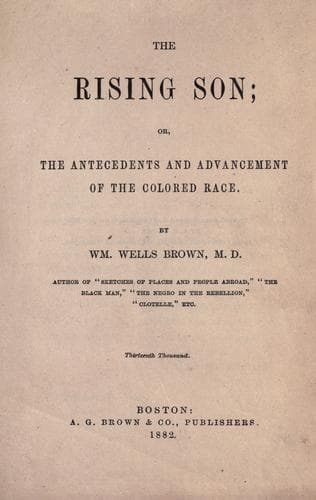
The Rising Son; or, the Antecedents and Advancement of the Colored RaceBrown, William Wells
History
The Rising Son; or, the Antecedents and Advancement of the Colored Race
Brown, William Wells
African Americans -- Biography; African Americans -- History; Black race; Slavery -- United States
The leader of the blacks was pointed out by the Spaniards, and his
name given as Joseph Cinque. He was a native of Africa, and one of the
finest specimens of his race ever seen in this country. As soon as he
saw that the vessel was in the hands of others, and all hope of his
taking himself and countrymen back to their home land at an end, he
leaped overboard with the agility of an antelope. The small boat was
immediately sent after him, and for two hours did the sailors strive
to capture him before they succeeded. Cinque swam and dived like an
otter, first upon his back, then upon his breast, sometimes his head
out of water, and sometimes his heels out. His countrymen on board
the captured schooner seemed much amused at the chase, for they knew
Cinque well, and felt proud of the untameableness of his nature. After
baffling them for a time, he swam towards the vessel, was taken on
board, and secured with the rest of the blacks, and they were taken
into New London, Connecticut.
The schooner proved to be the Amistad, Captain Ramon Ferrer, from
Havana, bound to Principe, about one hundred leagues distant, with
fifty-four negroes held as slaves, and two passengers. The Spaniards
said, that after being out four days, the negroes rose in the night and
killed the captain and a mulatto cook; that the helmsman and another
sailor took to the boat and went on shore; that the only two whites
remaining were the said passengers, Montez and Ruiz, who were confined
below until morning; that Montez the elder, who had been a sea-captain,
was required to steer the ship for Africa; that he steered easterly in
the day-time, because the negroes could tell his course by the sun,
but put the vessel about in the night. They boxed about some days in
the Bahama Channel, and were several times near the Islands, but the
negroes would not allow her to enter any port. Once they were near Long
Island, but then put out to sea again, the Spaniards all the while
hoping they might fall in with some ship of war that would rescue them
from their awkward situation. One of the Spaniards testified that when
the rising took place, he was awaked by the noise, and that he heard
the captain order the cabin boy to get some bread and throw it to the
negroes, in hope to pacify them. Cinque, however, the leader of the
revolt, leaped on deck, seized a capstan bar, and attacked the captain,
whom he killed at a single blow, and took charge of the vessel; his
authority being acknowledged by his companions, who knew him as a
prince in his native land.
After a long litigation in the courts, the slaves were liberated and
sent back to their native land.
In the following year, 1840, the brig Creole, laden with slaves, sailed
from Richmond, bound for New Orleans; the slaves mutinied, took the
vessel, and carried her into the British West Indies, and thereby
became free. The hero on this occasion was Madison Washington.
CHAPTER XL.
THE IRON AGE.
Public-domain text, read in full here on John Shaqi.
Reviews
Reviews
No reviews yet
Be the first to share your thoughts on this work.
Elsewhere in the archive
Join the Discussion
Join the discussion
Sign in to leave a comment or review.
Sign InorCreate an account