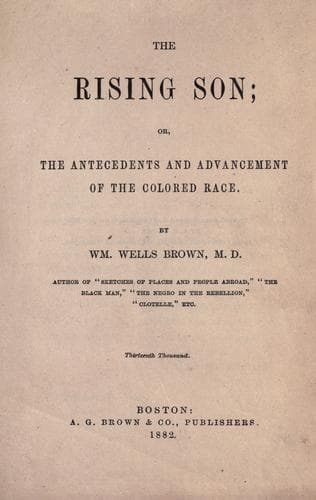
The Rising Son; or, the Antecedents and Advancement of the Colored RaceBrown, William Wells
History
The Rising Son; or, the Antecedents and Advancement of the Colored Race
Brown, William Wells
African Americans -- Biography; African Americans -- History; Black race; Slavery -- United States
The resolute and determined purpose of the Southerners to make the
institution of slavery national, and the equally powerful growing
public sentiment at the North to make freedom universal, showed plainly
that the nation was fast approaching a crisis on this absorbing
question. In Congress, men were compelled to take either the one or
the other side, and the debates became more fiery, as the subject
progressed.
John P. Hale led in the Senate, while Joshua R. Giddings was the
acknowledged leader in the House of Representatives in behalf of
freedom. On the part of slavery, the leadership in the Senate lay
between Foot of Mississippi, and McDuffie of South Carolina; while
Henry A. Wise, followed by a ravenous pack watched over the interest of
the “peculiar institution” in the House.
The early adoption of the famous “Gag Law,” whereby all petitions on
the subject of slavery were to be “tabled” without discussion, instead
of helping the Southern cause, brought its abettors into contempt. In
the House, Mr. Giddings was censured for offering resolutions in regard
to the capture of the brig Creole.
Mr. Giddings resigned, went home, was at once re-elected, and returned
to Congress to renew the contest. An attempt to expel John Quincy
Adams, for presenting a petition from a number of persons held in
slavery, was a failure, and from which the friends of the negro took
fresh courage.
In the South, the Legislatures were enacting laws abridging the
freedom of speech and of the press, and making it more difficult for
Northerners to travel in the slave states. Rev. Charles T. Torry was
in the Maryland Penitentiary for aiding slaves to escape, and Jonathan
Walker had been branded with a red-hot iron, and sent home for the same
offence. The free colored people of the South were being persecuted in
a manner hitherto unknown in that section. Amid all these scenes, there
was a moral contest going on at the North. The Garrison abolitionists,
whose head-quarters were in Boston, were at work with a zeal which has
scarcely ever been equalled by any association of men and women.
“The Liberator,” Mr. Garrison’s own paper, led the vanguard; while the
“National Anti-slavery Standard,” edited at times by Oliver Johnson,
Lydia Maria Child, David Lee Child, and Sydney Howard Gay, gave no
uncertain sound on the slavery question.
Public-domain text, read in full here on John Shaqi.
Reviews
Reviews
No reviews yet
Be the first to share your thoughts on this work.
Elsewhere in the archive
Join the Discussion
Join the discussion
Sign in to leave a comment or review.
Sign InorCreate an account