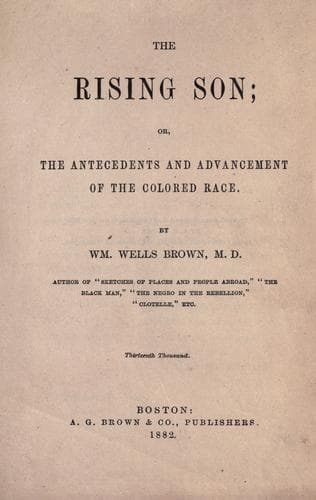
The Rising Son; or, the Antecedents and Advancement of the Colored RaceBrown, William Wells
History
The Rising Son; or, the Antecedents and Advancement of the Colored Race
Brown, William Wells
African Americans -- Biography; African Americans -- History; Black race; Slavery -- United States
One Nathaniel Gordon was already in prison in New York, and his trial
was fast approaching. It came, and he was convicted of piracy in the
United States District Court in the city of New York; the piracy
consisting in having fitted out a slaver, and shipped nine hundred
Africans at Congo River, with a view to selling them as slaves. The
same man had been tried for the same offence before; but the jury
failed to agree, and he accordingly escaped punishment for the time.
Every effort was made which the ingenuity of able lawyers could invent,
or the power of money could enforce, to save this miscreant from the
gallows; but all in vain; for President Lincoln utterly refused to
interfere in any way whatever, and Gordon was executed on the 7th of
February.
This blow appeared to give more offence to the commercial Copperheads
than even the emancipation of the slaves in the District of Columbia;
for it struck an effectual blow at a very lucrative branch of commerce,
in which the New Yorkers were largely interested. Thus it will be seen
that the nation was steadily moving on to the goal of freedom.
In September, 1862, the colored people of Cincinnati, Ohio, organized
the “Black Brigade,” and rendered eminent service in protecting that
city from the raids of John Morgan and other brigands.
On the first of January, 1863, President Lincoln put forth his
Emancipation Proclamation, as follows:--
“Whereas, On the 22d day of September, in the year of our Lord one
thousand eight hundred and sixty-three, a proclamation was issued
by the President of the United States, containing, among other
things, the following; to wit:
Public-domain text, read in full here on John Shaqi.
Reviews
Reviews
No reviews yet
Be the first to share your thoughts on this work.
Elsewhere in the archive
Join the Discussion
Join the discussion
Sign in to leave a comment or review.
Sign InorCreate an account