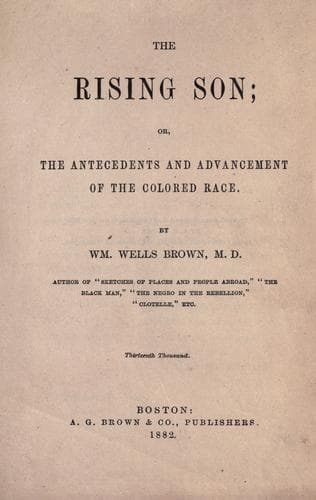
The Rising Son; or, the Antecedents and Advancement of the Colored RaceBrown, William Wells
History
The Rising Son; or, the Antecedents and Advancement of the Colored Race
Brown, William Wells
African Americans -- Biography; African Americans -- History; Black race; Slavery -- United States
It is probably well known that the free colored population of New
Orleans, in intelligence, public spirit, and material wealth, surpass
those of the same class in any other city of the Union. Many of these
gentlemen have been highly educated, have travelled extensively in this
and foreign countries, speak and read the French, Spanish, and English
languages fluently, and in the Exchange Rooms, or at the Stock Boards,
wield an influence at any time fully equal to the same number of white
capitalists. Before the war, they represented in that city alone
fifteen millions of property, and were heavily taxed to support the
schools of the State, but were not allowed to claim the least benefit
therefrom.
These gentlemen, representing so much intelligence, culture, and
wealth, and who would, notwithstanding the fact that they all have
negro blood in their veins, adorn any circle of society in the
North, who would be taken upon Broadway for educated and wealthy
Cuban planters, rather than free negroes, although many of them have
themselves held slaves, have always been loyal to the Union; and, when
New Orleans seemed in danger of being recaptured by the rebels under
General Magruder, these colored men rose _en masse_, closed their
offices and stores, armed and organized themselves into six regiments,
and for six weeks abandoned their business, and stood ready to fight
for the defence of New Orleans, while at the same time not a single
white regiment from the original white inhabitants was raised.
CHAPTER XLIV.
THE CAPITAL FREE.--PROCLAMATION OF FREEDOM.
In 1862 slavery was abolished in the District of Columbia, the honor of
which in the main belongs to Henry Wilson, Senator from Massachusetts.
With the abolition of slavery in the District of Columbia, commenced
a new era at our country’s capital. The representatives of the
governments of Hayti and Liberia had both long knocked in vain to be
admitted with the representatives of other nations. The slave power had
always succeeded in keeping them out. But a change had now come over
the dreams of the people, and Congress was but acting up to this new
light in passing the bill admitting the representatives of the black
republics.
As we have before stated, the slave-trade was still being carried on
between the Southern States and Africa. Ships were fitted out in the
Northern ports for the purpose of carrying on this infernal traffic.
And although it was prohibited by an act of Congress, none had ever
been convicted for dealing in slaves. The new order of things was to
give these trafficers a trial, and test the power by which they had so
long dealt in the bodies and souls of men whom they had stolen from
their native land.
Public-domain text, read in full here on John Shaqi.
Reviews
Reviews
No reviews yet
Be the first to share your thoughts on this work.
Elsewhere in the archive
Join the Discussion
Join the discussion
Sign in to leave a comment or review.
Sign InorCreate an account