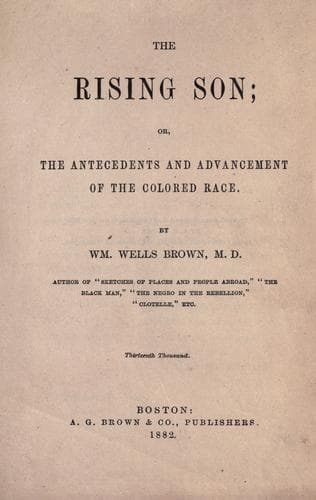
The Rising Son; or, the Antecedents and Advancement of the Colored RaceBrown, William Wells
History
The Rising Son; or, the Antecedents and Advancement of the Colored Race
Brown, William Wells
African Americans -- Biography; African Americans -- History; Black race; Slavery -- United States
“And by virtue of the power, for the purpose aforesaid, I do order
and declare that all persons held as slaves within said designated
States and parts of States are, and henceforward shall be, FREE;
and the Executive Government of the United States, including
the military and naval authorities thereof, will recognize and
maintain the freedom of such persons.
“And I hereby enjoin upon the people so declared to be free to
abstain from all violence, unless in necessary self-defence; and I
recommend to them, that, in all cases where allowed, they labor
faithfully for reasonable wages.
“And I further declare and make known, that such persons, if in
suitable condition, will be received into the armed service of
the United States, to garrison forts, positions, stations, and
other places, and to man vessels of all sorts in said service. And
upon this, sincerely believed to be an act of justice warranted
by the constitution, and upon military necessity, I invoke the
considerate judgment of mankind and the gracious favor of Almighty
God.
“In witness whereof I have hereunto set my hand, and caused the
seal of the United States to be affixed.
“Done at the city of Washington, this first day of January, in
the year of our Lord one thousand eight hundred and sixty-three,
and of the independence of the United States of America the
eighty-seventh.
(Signed) “ABRAHAM LINCOLN.”
CHAPTER XLV.
BLACKS ENLISTED, AND IN BATTLE.
Attorney-General Bates had already given his opinion with regard to
the citizenship of the negro, and that opinion was in the black man’s
favor. The Emancipation Proclamation was only a prelude to calling
on the colored men to take up arms, and the one soon followed the
other; for the word “Emancipation” had scarcely gone over the wires,
ere Adjutant-General Thomas made his appearance in the valley of the
Mississippi. At Lake Providence, Louisiana, he met a large wing of
the army, composed of volunteers from all parts of the country, and
proclaimed to them the new policy of the administration.
The Northern regiments stationed at the South, or doing duty in that
section, had met with so many reverses on the field of battle, and had
been so inhumanly treated by the rebels, both men and women, that the
new policy announced by Adjutant-General Thomas at Lake Providence and
other places, was received with great favor, especially when the white
soldiers heard from their immediate commanders that the freedmen when
enlisted would be employed in doing fatigue-duty, when not otherwise
needed. The slave, regarding the use of the musket as the only means
of securing his freedom permanently, sought the nearest place of
enlistment with the greatest speed.
Public-domain text, read in full here on John Shaqi.
Reviews
Reviews
No reviews yet
Be the first to share your thoughts on this work.
Elsewhere in the archive
Join the Discussion
Join the discussion
Sign in to leave a comment or review.
Sign InorCreate an account