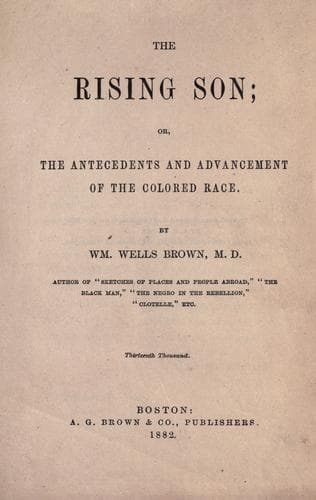
The Rising Son; or, the Antecedents and Advancement of the Colored RaceBrown, William Wells
History
The Rising Son; or, the Antecedents and Advancement of the Colored Race
Brown, William Wells
African Americans -- Biography; African Americans -- History; Black race; Slavery -- United States
The appointment of men from the ranks of the white regiments over the
blacks caused the former to feel still more interest in the new levies.
The position taken by Major-General Hunter, in South Carolina, and
his favorable reports of the capability of the freedmen for military
service, and the promptness with which that distinguished scholar and
Christian gentleman, Thomas Wentworth Higginson, accepted the colonelcy
of the First South Carolina, made the commanding of negro regiments
respectable, and caused a wish on the part of white volunteers to seek
commissions over the blacks.
The new regiments filled up rapidly; the recruits adapted themselves
to their new condition with a zeal that astonished even their friends;
and their proficiency in the handling of arms, with only a few days’
training, set the minds of their officers at rest with regard to their
future action.
On the 7th of June, 1863, the first regular battle was fought between
the blacks and whites in the valley of the Mississippi. The planters
had boasted, that, should they meet their former slaves, a single look
from them would cause the negroes to throw down their weapons, and run.
Many Northern men, especially Copperheads, professed to believe that
such would be the case. Therefore, all eyes were turned to the far-off
South, the cotton, sugar, and rice-growing States, to see how the
blacks would behave on the field of battle; for it is well known that
the most ignorant of the slave population belonged in that section.
The first intimation that the commanding officer at Milliken’s Bend
received was from one of the black men, who went into the colonel’s
tent, and said, ‘Massa, the secesh are in camp.’ The colonel ordered
him to have the men load their guns at once. He instantly replied,--
“We have done did dat now, massa.” Before the colonel was ready, the
men were in line, ready for action.
“The enemy charged us so close that we fought with our bayonets, hand
to hand. I have six broken bayonets to show how bravely my men fought,”
said the colonel. “I can truly say,” continued he, “that I never saw a
braver company of men in my life.
“Not one of them offered to leave his place until ordered to fall back.
I went down to the hospital, three miles, to-day, to see the wounded.
Nine of them were there, two having died of their wounds. A boy who had
cooked for me came and begged a gun when the rebels were advancing, and
took his place with the company; and when we retook the breastworks, I
found him badly wounded, with one gun-shot and two bayonet wounds. A
new recruit I had issued a gun to the day before the fight was found
dead, with a firm grasp on his gun, the bayonet of which was broken
in three pieces. So they fought and died, defending the cause that we
revere. They met death coolly, bravely; not rashly did they expose
themselves, but all were steady and obedient to orders.”
Public-domain text, read in full here on John Shaqi.
Reviews
Reviews
No reviews yet
Be the first to share your thoughts on this work.
Elsewhere in the archive
Join the Discussion
Join the discussion
Sign in to leave a comment or review.
Sign InorCreate an account