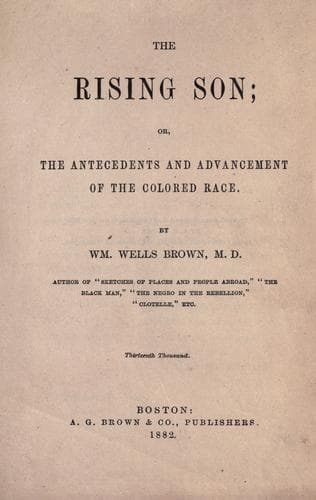
The Rising Son; or, the Antecedents and Advancement of the Colored RaceBrown, William Wells
History
The Rising Son; or, the Antecedents and Advancement of the Colored Race
Brown, William Wells
African Americans -- Biography; African Americans -- History; Black race; Slavery -- United States
This battle satisfied the slave-masters of the South that their
charm was gone; and that the negro, as a slave, was lost forever.
Yet there was one fact connected with the battle of Milliken’s Bend
which will descend to posterity, as testimony against the humanity of
slave-holders; and that is, that no negro was ever found alive that was
taken a prisoner by the rebels in this fight.
The next engagement which the blacks had, was up the St. Mary’s River,
South Carolina, under the command of Colonel T. W. Higginson. Here,
too, the colored men did themselves and their race great credit.
We now come to the battle of Port Hudson, in which the black forces
consisted of the First Louisiana, under Lieutenant-Colonel Bassett, and
the Third Louisiana, under Colonel Nelson. The line-officers of the
Third were white; and the regiment was composed mostly of freedmen,
many of whose backs still bore the marks of the lash, and whose brave,
stout hearts beat high at the thought that the hour had come when they
were to meet their proud and unfeeling oppressors.
The First was the noted regiment called “The Native Guard,” which
General Butler found when he entered New Orleans, and which so
promptly offered its services to aid in crushing the Rebellion. The
line-officers of this regiment were all colored, taken from amongst the
most wealthy and influential of the free colored people of New Orleans.
It was said that not one of them was worth less than twenty-five
thousand dollars. The brave, the enthusiastic, and the patriotic, found
full scope for the development of their powers in this regiment, of
which all were well educated; some were fine scholars. One of the most
efficient officers was Captain André Callioux, a man whose identity
with his race could not be mistaken. This regiment petitioned their
commander to allow them to occupy the post of danger in the battle, and
it was granted.
As the moment of attack drew near, the greatest suppressed excitement
existed; but all were eager for the fight. Captain Callioux walked
proudly up and down the line, and smilingly greeted the familiar faces
of his company. Officers and privates of the white regiments looked
on as they saw these men at the front, and asked each other what they
thought would be the result. Would these blacks stand fire? Was not
the test by which they were to be tried too severe? Colonel Nelson
being called to act as brigadier-general, Lieutenant-Colonel Finnegas
took his place. The enemy in his stronghold felt his power, and bade
defiance to the expected attack. At last the welcome word was given,
and our men started. The enemy opened a blistering fire of shell,
canister, grape, and musketry. The first shell thrown by the enemy
killed and wounded a number of the blacks; but on they went. “Charge”
was the word.
Public-domain text, read in full here on John Shaqi.
Reviews
Reviews
No reviews yet
Be the first to share your thoughts on this work.
Elsewhere in the archive
Join the Discussion
Join the discussion
Sign in to leave a comment or review.
Sign InorCreate an account