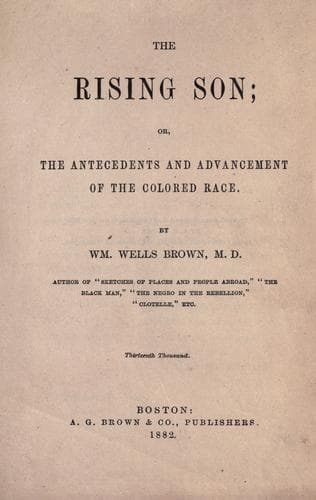
The Rising Son; or, the Antecedents and Advancement of the Colored RaceBrown, William Wells
History
The Rising Son; or, the Antecedents and Advancement of the Colored Race
Brown, William Wells
African Americans -- Biography; African Americans -- History; Black race; Slavery -- United States
Shells from the rebel guns cut down trees three feet in diameter, and
they fell, at one time burying a whole company beneath their branches.
Thus they charged bravely on certain destruction, till the ground was
slippery with the gore of the slaughtered, and cumbered with the bodies
of the maimed. The last charge was made about one o’clock. At this
juncture, Captain Callioux was seen with his left arm dangling by his
side,--for a ball had broken it above the elbow,--while his right hand
held his unsheathed sword gleaming in the rays of the sun; and his
hoarse, faint voice was heard cheering on his men. A moment more, and
the brave and generous Callioux was struck by a shell, and fell far in
advance of his company.
The fall of this officer so exasperated his men, that they appeared
to be filled with new enthusiasm; and they rushed forward with a
recklessness that probably has never been surpassed. Seeing it to be
a hopeless effort, the taking of these batteries, the order was given
to change the programme; and the troops were called off. But had they
accomplished anything more than the loss of many of their brave men?
Yes; they had. The self-forgetfulness, the undaunted heroism, and the
great endurance of the Negro, as exhibited that day, created a new
chapter in American history for the colored man.
Many Persians were slain at the battle of Thermopylæ; but history
records only the fall of Leonidas and his four hundred companions. So
in the future, when we shall have passed away from the stage, and
rising generations shall speak of the conflict at Port Hudson, and the
celebrated charge of the negro brigade, they will forget all others in
the admiration for André Callioux and his colored associates. General
Banks, in his report of the battle of Port Hudson, says: “Whatever
doubt may have existed heretofore as to the efficiency of organizations
of this character, the history of this day proves conclusively to those
who were in a condition to observe the conduct of these regiments, that
the government will find in this class of troops effective supporters
and defenders. The severe test to which they were subjected, and the
determined manner in which they encountered the enemy, leaves upon my
mind no doubt of their ultimate success.”
The splendid behavior of the blacks in the valley of the Mississippi,
was soon equalled by the celebrated Fifty-fourth Massachusetts
Regiment, commanded by the lamented Robert G. Shaw.
Public-domain text, read in full here on John Shaqi.
Reviews
Reviews
No reviews yet
Be the first to share your thoughts on this work.
Elsewhere in the archive
Join the Discussion
Join the discussion
Sign in to leave a comment or review.
Sign InorCreate an account