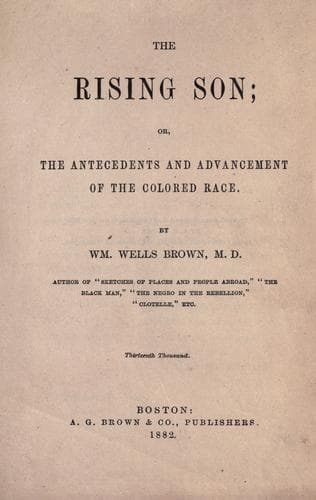
The Rising Son; or, the Antecedents and Advancement of the Colored RaceBrown, William Wells
History
The Rising Son; or, the Antecedents and Advancement of the Colored Race
Brown, William Wells
African Americans -- Biography; African Americans -- History; Black race; Slavery -- United States
Colonel Hartwell gave the order; the colors came to the extreme front,
when the colonel shouted, “Follow your colors!” The bugle sounded the
charge, and then the colonel led the way himself.
After an unsuccessful charge in line of battle by the Fifty-fourth and
Fifty-fifth Massachusetts, the Fifty-fifth was formed in column by
company, and again thrice marched up that narrow causeway in the face
of the enemy’s batteries and musketry.
Captain Crane, of the Fifty-fifth Massachusetts, whose company had been
left in charge of Fort Delafield, at Folly Island, but who, at his own
request, had gone as aide to Colonel Hartwell, was, as well as the
colonel, mounted.
Just as they reached the marsh in front of the turn in the road, and
within a short distance of the rebel works, the horse of brave Colonel
Hartwell, while struggling through the mud, was literally blown in
pieces by a discharge of canister.
The colonel was wounded at the same time, and attempted to jump from
his horse; but the animal fell on him, pressing him into the mud.
At this time, he was riding at the side of the column, and the men
pressed on past; but as they neared the fort they met a murderous fire
of grape, canister, and bullets at short range. As the numbers of the
advance were thinned, the few who survived began to waver, and finally
the regiment retreated.
In retiring, Lieutenant Ellsworth, and one man of the Fifty-fifth
Massachusetts, came to the rescue of Colonel Hartwell, and in spite
of his remonstrance that they should leave him to his fate, and take
care of themselves, released him from his horse, and bore him from the
field. But before he was entirely out of range of the enemy’s fire,
the colonel was again wounded, and the brave private soldier who was
assisting was killed, and another heroic man lost.
The Twenty-fifth Ohio, soon after the commencement of the engagement,
were sent to the right, where they swung around, and fought on a line
nearly perpendicular to our main front. A portion of the Fifty-fifth
Massachusetts were with them. One or two charges were essayed, but
were unsuccessful; but the front was maintained there throughout the
afternoon. The Twenty-fifth had the largest loss of all the regiments.
The colored troops fought well throughout the day. Counter-charges were
made at various times during the fight by the enemy; but our infantry
and artillery mowed them down, and they did not at any time get very
near our lines. Whenever a charge of our men was repulsed, the rebels
would flock out of their works, whooping like Indians; but Ames’s guns
and the terrible volleys of our infantry would send them back. The
Naval Brigade behaved splendidly.
Public-domain text, read in full here on John Shaqi.
Reviews
Reviews
No reviews yet
Be the first to share your thoughts on this work.
Elsewhere in the archive
Join the Discussion
Join the discussion
Sign in to leave a comment or review.
Sign InorCreate an account