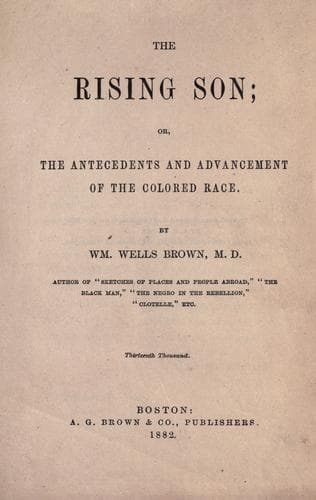
The Rising Son; or, the Antecedents and Advancement of the Colored RaceBrown, William Wells
History
The Rising Son; or, the Antecedents and Advancement of the Colored Race
Brown, William Wells
African Americans -- Biography; African Americans -- History; Black race; Slavery -- United States
Honey Hill is about two and a half miles east of the village of
Grahamville, Beaufort District. On the crest of this, where the road
or the highway strikes it, is a semicircular line of earthworks,
defective, though, in construction, as they are too high for infantry,
and have little or no exterior slope. These works formed the centre
of the rebel lines; while their left reached up into the pinelands,
and their right along a line of fence that skirted the swamp below the
batteries. They commanded fully the road in front as it passes through
the swamp at the base of the hill, and only some fifty or sixty yards
distant. Through the swamp runs a small creek, which spreads up and
down the roads for some thirty or forty yards, but is quite shallow the
entire distance. Some sixty yards beyond the creek, the main road turns
off to the left, making an obtuse angle; while another and smaller road
makes off to the right from the same point.
The Union forces consisted of six thousand troops, artillery, cavalry,
and infantry, all told, under the command of Major-General J. G.
Foster, General John P. Hatch having the immediate command. The First
Brigade, under General E. E. Potter, was composed of the Fifty-sixth
and One Hundred and Forty-fourth United States, Twenty-fifth Ohio,
and Thirty-fourth and Thirty-fifth United States (colored). The Second
Brigade, under Colonel A. S. Hartwell, was composed of the Fifty-fourth
and Fifty-fifth Massachusetts, and Twenty-sixth and Thirty-second
United States (colored). Colonel E. P. Hallowell, of the Fifty-fourth
Massachusetts, had, in spite of his express desire, been left behind in
command of Morris and Folly Islands. As at the battle of Olustee, the
enemy was met in small numbers some three or four miles from his base.
The Union forces approached the fort by the left road, which brought
them in front of the enemy’s guns, pointing down the hill, which was
also down the road.
The Thirty-second United States colored troops were ordered to charge
the rebel fort; had got in position at the head of the road. They
attempted, but got stuck in the marsh, which they found impassable at
the point of their assault; and a galling fire of grape, canister, and
musketry being opened on them, they were forced to retire.
The Thirty-fourth United States colored troops also essayed an assault,
but could not get near enough to produce any effect upon it. These
regiments, however, only fell back to the line of battle, where they
remained throughout the entire fight.
The Fifty-fifth Massachusetts (colored) went into the fight on the
right of the brigade, commanded by Colonel Hartwell. The fire became
very hot; but still the regiment did not waver, the line merely
quivered. Captain Goraud, of General Foster’s staff, whoso gallantry
was conspicuous all day, rode up just as Colonel Hartwell was wounded
in the hand, and advised him to retire; but the colonel declined.
Public-domain text, read in full here on John Shaqi.
Reviews
Reviews
No reviews yet
Be the first to share your thoughts on this work.
Elsewhere in the archive
Join the Discussion
Join the discussion
Sign in to leave a comment or review.
Sign InorCreate an account