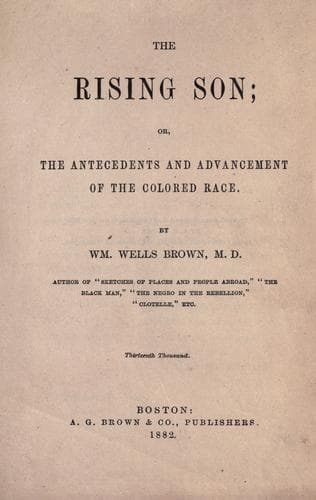
The Rising Son; or, the Antecedents and Advancement of the Colored RaceBrown, William Wells
History
The Rising Son; or, the Antecedents and Advancement of the Colored Race
Brown, William Wells
African Americans -- Biography; African Americans -- History; Black race; Slavery -- United States
Never was self-sacrifice, by both officers and men, more apparent than
on this occasion; never did men look death more calmly in the face.
See the undaunted and heroic Hartwell at the head of his regiment, and
hear him shouting, “Follow your colors, my brave men!” and with drawn
sword leading his gallant band. His horse is up to its knees in the
heavy mud. The rider, already wounded, is again struck by the fragment
of a shell, but keeps his seat; while the spirited animal struggling
in the mire, and plunging about, attracts the attention of the braves,
who are eagerly pressing forward to meet the enemy, to retake the lost
ground, and gain a victory, or at least, save the little army from
defeat. A moment more, he is killed; and the brave Hartwell attempts to
jump from his charger, but is too weak. The horse falls with fearful
struggles upon its rider, and both are buried in the mud. The brave
Captain Crane, the Adjutant, is killed, and falls from his horse near
his colonel. Lieutenant Boynton, while urging his men, is killed.
Lieutenant Hill is wounded, but still keeps his place. Captains Soule
and Woodward are both wounded, and yet keep their command. The blood
is running freely from the mouth of Lieutenant Jewett; but he does not
leave his company. Sergeant-Major Trotter is wounded, but still fights.
Sergeant Shorter is wounded in the knee, yet will not go to the rear. A
shell tears off the foot of Sergeant-Major Charles L. Mitchel; and as
he is carried to the rear, he shouts, with uplifted hand, “Cheer up,
boys; we’ll never surrender!” But look away in front: there are the
colors, and foremost amongst the bearers is Robert M. King, the young,
the handsome, and the gentlemanly sergeant, whose youth and bravery
attract the attention of all. Scarcely more than twenty years of age,
well educated, he left a good home in Ohio to follow the fortunes of
war, and to give his life to help redeem his race. The enemy train
their guns upon the colors, the roar of cannon and crack of rifle is
heard, the advanced flag falls, the heroic King is killed; no, he is
not dead, but only wounded. A fellow-sergeant seizes the colors; but
the bearer will not give them up. He rises, holds the old flag aloft
with one hand, and presses the other upon the wound in his side to
stop the blood. “Advance the colors!” shouts the commander. The brave
King, though saturated with his own blood, is the first to obey the
order. As he goes forward, a bullet passes through his heart, and he
falls. Another snatches the colors; but they are fast, the grasp of
death holds them tight. The hand is at last forced open, the flag is
raised to the breeze, and the lifeless body of Robert M. King is borne
from the field. This is but a truthful sketch of the part played by one
heroic son of Africa, whose death was lamented by all who knew him.
This is only one of the two hundred and forty-nine that fell on the
field of Honey Hill. With a sad heart we turn away from the picture.
Public-domain text, read in full here on John Shaqi.
Reviews
Reviews
No reviews yet
Be the first to share your thoughts on this work.
Elsewhere in the archive
Join the Discussion
Join the discussion
Sign in to leave a comment or review.
Sign InorCreate an account