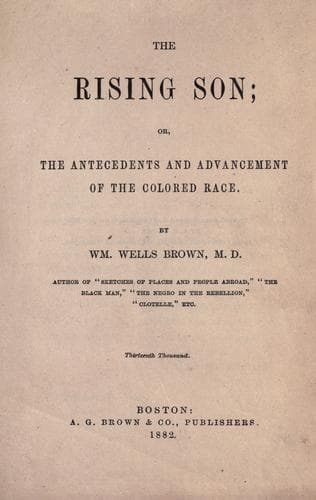
The Rising Son; or, the Antecedents and Advancement of the Colored RaceBrown, William Wells
History
The Rising Son; or, the Antecedents and Advancement of the Colored Race
Brown, William Wells
African Americans -- Biography; African Americans -- History; Black race; Slavery -- United States
The Sixth Regiment United States colored troops was the second
which was organized at Camp William Penn, near Philadelphia, by
Lieutenant-Colonel Wagner, of the Eighty-eighth Pennsylvania
Volunteers. The regiment left Philadelphia on the 14th of October,
1863, with nearly eight hundred men, and a full complement of officers,
a large majority of whom had been in active service in the field.
The regiment reported to Major-General B. F. Butler, at Fortress
Monroe, and were assigned to duty at Yorktown, Virginia, and became
part of the brigade (afterwards so favorably known), under the
command of Colonel S. A. Duncan, Fourth United States colored troops.
Here they labored upon the fortifications, and became thoroughly
disciplined under the tuition of their colonel, John W. Ames, formerly
captain of the Eleventh Infantry, United States army, ably seconded
by Lieutenant-Colonel Royce and Major Kiddoo. During the winter,
the regiment took a prominent part in the several raids made in the
direction of Richmond, and exhibited qualities that elicited the praise
of their officers, and showed that they could be fully relied upon in
more dangerous work.
The regiment was ordered to Camp Hamilton, Virginia, in May, 1864,
where a division of colored troops was formed, and placed under the
command of Brigadier-General Hinks. In the expedition made up the James
River the same month, under General Butler, this division took part.
The white troops were landed at Bermuda Hundreds. Three regiments of
colored men were posted at various points along the river. Duncan’s
brigade landed at City Point, where they immediately commenced
fortifications. The Sixth and Fourth Regiments were soon after removed
to Spring Hill, within five miles of Petersburg. Here they labored
night and day upon those earthworks which were soon to be the scene of
action which was to become historical. The Sixth was in a short time
left alone, by the removal of the Fourth Regiment to another point.
On the 29th of May, the rebel forces made an assault on the
picket-line, the enemy soon after attacking in strong force, but were
unable to drive back the picket-line any considerable distance. The
Fourth Regiment was ordered to the assistance of the Sixth; but our
forces were entirely too weak to make it feasible or prudent to attack
the enemy, who withdrew during the night, having accomplished nothing.
Public-domain text, read in full here on John Shaqi.
Reviews
Reviews
No reviews yet
Be the first to share your thoughts on this work.
Elsewhere in the archive
Join the Discussion
Join the discussion
Sign in to leave a comment or review.
Sign InorCreate an account