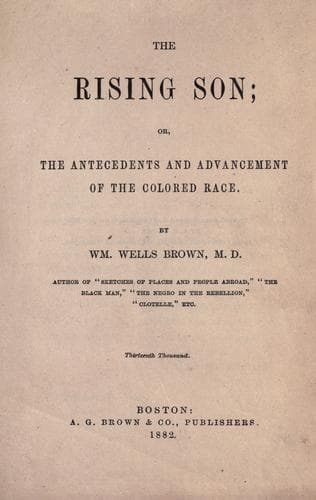
The Rising Son; or, the Antecedents and Advancement of the Colored RaceBrown, William Wells
History
The Rising Son; or, the Antecedents and Advancement of the Colored Race
Brown, William Wells
African Americans -- Biography; African Americans -- History; Black race; Slavery -- United States
However, the selection of E. D. Bassett, as Minister and Consul-General
to Hayti, astonished even those who had the most favorable opinion of
President Grant, and satisfied the people generally, both colored and
white. Since the close of the war, colored men have been appointed to
honorable situations in the Custom Houses in the various States, also
in the Post Office and Revenue Department.
CHAPTER XLVIII.
THE ABOLITIONISTS.
A little more than forty years ago, William Lloyd Garrison hoisted the
banner of immediate and unconditional emancipation, as the right of
the slave, and the duty of the master. The men and women who gradually
rallied around him, fully comprehended the solemn responsibility they
were then taking, and seemed prepared to consecrate the best years
of their lives to the cause of human freedom. Amid the moral and
political darkness which then overshadowed the land, the voice of
humanity was at length faintly heard, and soon aroused opposition; for
slavery was rooted and engrafted in every fibre of American society.
The imprisonment of Mr. Garrison at Baltimore, at once directed public
attention to the heinous sin which he was attacking, and called around
him some of the purest and best men of the country.
The Boston mob of 1835 gave now impulse to the agitation, and brought
fresh aid to the pioneer of the movement. Then came the great battle
for freedom of speech and the press; a battle in which the heroism of
this small body of proscribed men and women had ample room to show
their genius and abilities. The bold and seeming audacity with which
they attacked slavery in every corner where the monster had taken
refuge, even in the face of lynchings, riots, and murders, carried with
it a charm which wrung applause from the sympathizing heart throughout
the world, and showed that the American Abolitionists possessed a
persistency and a courage which had never found a parallel in the
annals of progress and reform.
In the spring of 1859, we attended a meeting of the Executive Committee
of the American Anti-slavery Society, as it was then organized, and
we shall write of the members as they appeared at that time. The
committee was composed of twelve persons besides the chairman, and were
seated around a long table. At the head of the table sat William Lloyd
Garrison, the Chairman of the Board, and the acknowledged leader of the
movement. His high and prominent forehead, piercing eye, pleasant, yet
anxious countenance, long nose, and smile upon his lips, point him out
at once as a man born to guide and direct.
Public-domain text, read in full here on John Shaqi.
Reviews
Reviews
No reviews yet
Be the first to share your thoughts on this work.
Elsewhere in the archive
Join the Discussion
Join the discussion
Sign in to leave a comment or review.
Sign InorCreate an account