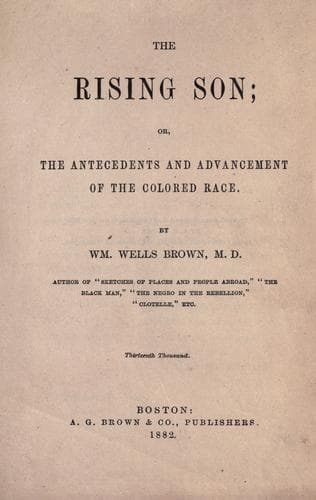
The Rising Son; or, the Antecedents and Advancement of the Colored RaceBrown, William Wells
History
The Rising Son; or, the Antecedents and Advancement of the Colored Race
Brown, William Wells
African Americans -- Biography; African Americans -- History; Black race; Slavery -- United States
The acknowledgment of the civil rights of the negro had already been
granted, in the admission of John S. Rock, a colored man, to practice
law in all the counties within the jurisdiction of the United States.
John F. Shorter, who was promoted to a lieutenancy in Company D,
Fifty-fifth Massachusetts Regiment, was by trade a carpenter, and was
residing in Delaware County, Ohio, when the call was made for colored
troops. Severely wounded at the battle of Honey Hill, South Carolina,
on the 30th of November, 1864, he still remained with his regiment,
hoping to be of service.
At the conclusion of the war, he returned home, but never recovered
from his wound, and died a few days after his arrival. James Monroe
Trotter, promoted for gallantry, was wounded at the battle of Honey
Hill. He is a native of Grand Gulf, Mississippi; removed to Cincinnati,
Ohio; was educated at the Albany (Ohio) Manual Labor University, where
he distinguished himself for his scholarly attainments. He afterwards
became a school-teacher, which position he filled with satisfaction
to the people of Muskingum and Pike Counties, Ohio, and with honor
to himself. Enlisting as a private in the Fifty-fifth Massachusetts
Regiment, on its organization, he returned with it to Boston as a
lieutenant, an office honorably earned.
William H. Dupree, a native of Petersburg, Virginia, was brought up
and educated at Chillicothe, Ohio. He enlisted in the Fifty-fifth
Massachusetts Regiment, on its formation, as a private, was soon made
orderly-sergeant, and afterwards promoted to a lieutenancy for bravery
on the field of battle.
Charles L. Mitchel, promoted to a lieutenancy in the Fifty-fifth
Massachusetts Regiment for gallantry at the battle of Honey Hill, where
he was severely wounded (losing a limb), is a native of Hartford,
Connecticut, and son of William A. Mitchel of that city. Lieutenant
Mitchel served an apprenticeship to William H. Burleigh, in the office
of the old “Charter Oak,” in Hartford, where he became an excellent
printer. For five or six years previous to entering the army, he was
employed in different printing-offices in Boston, the last of which was
“The Liberator,” edited by William Lloyd Garrison, who never speaks of
Lieutenant Mitchel but in words of the highest commendation. General
A. S. Hartwell, late colonel of the Fifty-fifth Massachusetts Regiment,
makes honorable mention of Lieutenant Mitchel.
In the year 1867, Mr. Mitchel was elected to the Massachusetts
Legislature, from Ward Six, in Boston. The appointment of John M.
Langston to a position in the Freedman Bureau, showed progress.
Public-domain text, read in full here on John Shaqi.
Reviews
Reviews
No reviews yet
Be the first to share your thoughts on this work.
Elsewhere in the archive
Join the Discussion
Join the discussion
Sign in to leave a comment or review.
Sign InorCreate an account