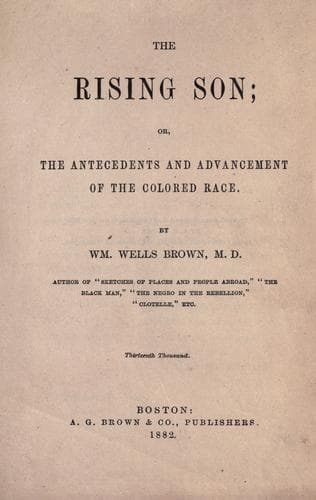
The Rising Son; or, the Antecedents and Advancement of the Colored RaceBrown, William Wells
History
The Rising Son; or, the Antecedents and Advancement of the Colored Race
Brown, William Wells
African Americans -- Biography; African Americans -- History; Black race; Slavery -- United States
Nature has treated Mr. Phillips as a favorite. His expressive
countenance paints and reflects every emotion of his soul. His
gestures, like his delivery, are wonderfully graceful. There is a
fascination in the soft gaze of his eyes, which none can but admire.
Being a close student, and endowed by Nature with a retentive memory,
he supplies himself with the most complicated dates and historical
events. Nothing can surpass the variety of his matter. He extracts
from a subject all that it contains, and does it as none but Wendell
Phillips can. His voice is beautifully musical, and it is calculated
to attract wherever it is heard. He is a man of calm intrepidity, of
a patriotic and warm heart, with temper the most gentle, a rectitude
of principle entirely natural, a freedom from ambition, and a modesty
quite singular.
His speeches upon every subject upon which he has spoken, will
compare favorably with anything ever uttered by Pitt or Sheridan in
their palmiest days. No American is so eagerly reported in Europe,
in what he says on the platform, as Mr. Phillips. His appeal for
Cretan independence was circulated in the language of Demosthenes and
Isocrates through Greece and its islands, and reached the ears of the
mountaineers of Crete, for whom he spoke.
But it is in the Anti-slavery cause that we love to write of him. As a
speaker on that platform, he has never had an equal; and the good he
has rendered the slave by his eloquent speeches can never be estimated.
Considering his position in society, his talents and prospects when in
youth he entered the ranks of the proscribed and hated Abolitionists,
we feel that Mr. Phillips has sacrificed more upon the altar of freedom
than any other living man.
On the opposite side of the table from Mr. Phillips, sits Edmund
Quincy, the ripe scholar and highly-cultivated gentleman and
interesting writer. If he is not so eloquent a speaker as his friend
Phillips, he is none the less staunch in his adherence to principle. He
is one of the best presiding officers that New England can produce.
A little farther down on the same side is Francis Jackson. His calm
Roman face, large features, well-developed head, and robust-looking
frame tells you at once that he is a man of courage. He was one of
the first to take his stand by the side of Mr. Garrison; and when the
mob in 1835 broke up the anti-slavery meeting held by the ladies, Mr.
Jackson, with a moral courage scarcely ever equalled, came forward and
offered his private dwelling to them to hold their meeting in.
Public-domain text, read in full here on John Shaqi.
Reviews
Reviews
No reviews yet
Be the first to share your thoughts on this work.
Elsewhere in the archive
Join the Discussion
Join the discussion
Sign in to leave a comment or review.
Sign InorCreate an account