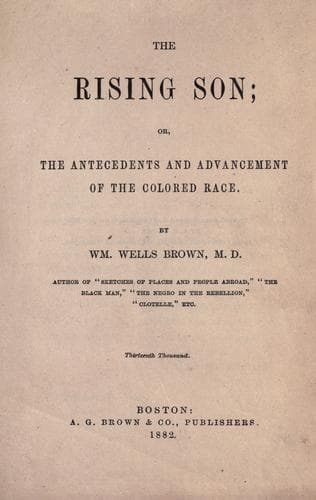
The Rising Son; or, the Antecedents and Advancement of the Colored RaceBrown, William Wells
History
The Rising Son; or, the Antecedents and Advancement of the Colored Race
Brown, William Wells
African Americans -- Biography; African Americans -- History; Black race; Slavery -- United States
Still farther down on the same side sits Maria Weston Chapman, the
well-read and accomplished lady, the head and heart of the Anti-slavery
Bazaar. Many an influential woman has been induced to take part in
the Bazaar and Subscription Festival, solely on account of the earnest
eloquence and polished magnetism of Mrs. Chapman. By her side sits her
gifted little sister, Anne Warren Weston. On the opposite side of the
table is Samuel May, Jr., the able and efficient general agent of the
Society. To his perseverance, industry, gentlemanly manners, and good
sense, the Society owes much of its success. In the earlier days of the
movement, Mr. May left the pulpit and a lucrative salary, that he might
devote his time to the cause in which his heart had long been engaged.
Mr. May is an earnest speaker, and never takes the platform unless
he has something to say. He is simple, plain, and one of the best of
friends. It was the good fortune of the writer to be associated with
him for a number of years; and he never looks back to those days but
with the best feeling and most profound respect for the moral character
and Christian worth of Samuel May, Jr.
Not far from Mr. May sat Charles F. Hovey, the princely Summer Street
merchant, the plain, honest, outspoken man whose heart felt the wrongs
of the oppressed as keenly as if he himself had been one of the race.
Gathered since to his heavenly rest, he bequeathed a large sum of
money to carry on the battle for the negro’s freedom. Farther down the
table was Eliza Lee Follen, whose poems in favor of liberty have so
often been sung in our anti-slavery conventions. Sydney Howard Gay,
the polished writer, the editor of the Society’s organ, occupied a
seat next to Mrs. Follen. With small frame, finely-cut features, and
pleasant voice, he is ever listened to with marked attention. Mr. Gay
is a gentleman in every sense of the term.
Near the end of the table is William I. Bowditch, the able scholar, the
ripe lawyer, the devoted friend of freedom. Lastly, there is Charles
K. Whipple, the “C. K. W.,” of “The Liberator,” and the “North,” of
the “Anti-slavery Standard.” A stronger executive board for a great
moral object probably never existed. They were men and women in whom
the public had the utmost confidence, individually, for rectitude of
character.
There were also present on this occasion five persons who were not
members of the board, but whose long and arduous labors entitled them
to a seat around the table. These were Samuel J. May, Lydia Maria
Child, James and Lucretia Mott, and Thomas Garrett; and of these we
shall now make mention.
Public-domain text, read in full here on John Shaqi.
Reviews
Reviews
No reviews yet
Be the first to share your thoughts on this work.
Elsewhere in the archive
Join the Discussion
Join the discussion
Sign in to leave a comment or review.
Sign InorCreate an account