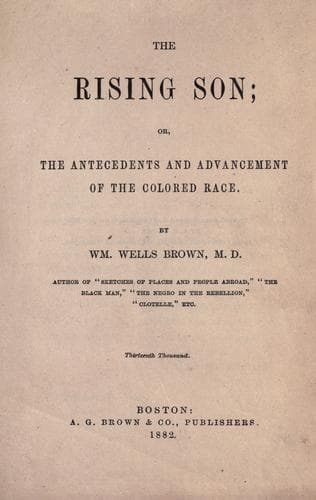
The Rising Son; or, the Antecedents and Advancement of the Colored RaceBrown, William Wells
History
The Rising Son; or, the Antecedents and Advancement of the Colored Race
Brown, William Wells
African Americans -- Biography; African Americans -- History; Black race; Slavery -- United States
As a speaker, Mrs. Foster is logical, forcible; leaping from irony to
grave argument. Her illustrations, anecdotes, and figures are always to
the point. She is sharp and quick at repartee. In the earlier days of
the movement, she was considered very able in discussion. At Buffalo,
where we first heard her, she basted one of our ablest lawyers until
he acknowledged the fact, amid loud applause. Mrs. Foster was at times
harsh, but not harsher than truth. She is uncompromising, and always
reliable in a public meeting where discussion on reformatory questions
is under consideration. This lady gave the best years of her useful
life to the redemption of the negro from slavery.
We may well give Stephen S. Foster a place by the side of his noble
wife. He, too, embraced the cause of the slave at the dawn of the
agitation of the subject, and at once became one of its ablest
advocates. In downright field-work, as a lecturer, he did more than any
other man. Mr. Foster was the most unpopular of all the anti-slavery
agents; and simply because he “hewed to the line and the plummet,”
not caring in whose face the chips flew. He was always at home in a
discussion, and woe betide the person who fell into his hands. His
announcement of his subject often startled his hearers, and even his
best friends and associates would sometimes feel that he had overstated
the question. But he always more than proved what he had said in the
outset. In private life he is almost faultless; proverbially honest,
trustworthy, and faithful in all his dealings, possessing in the
estimation of his neighbors a high moral character.
Parker Pillsbury entered the field as an advocate of freedom about the
same time as did Mr. Foster, and battled nobly for the oppressed.
Charles L. Remond was, we believe, the first man of color to take the
platform as a regular lecturer in the anti-slavery cause, and was, no
doubt, the ablest representative that the race had till the appearance
of Frederick Douglass, in 1842. Mr. Remond prided himself more as the
representative of the educated free man of color, and often alluded to
the fact that “not a drop of slave blood” coursed through his veins.
Mr. Remond has little or no originality, but his studied elocutionary
powers, and fine flow of language, together with his being a colored
man, always gained for him an attentive hearing. But the genius and
originality of Frederick Douglass, and his unadorned eloquence,
overshadowed and threw Remond in the shade. This so soured the latter
that he never recovered from it, and even at the present time speaks
disparagingly of his early friend and associate. However, both of these
gentlemen did much to bring about the abolition of American Slavery.
Public-domain text, read in full here on John Shaqi.
Reviews
Reviews
No reviews yet
Be the first to share your thoughts on this work.
Elsewhere in the archive
Join the Discussion
Join the discussion
Sign in to leave a comment or review.
Sign InorCreate an account