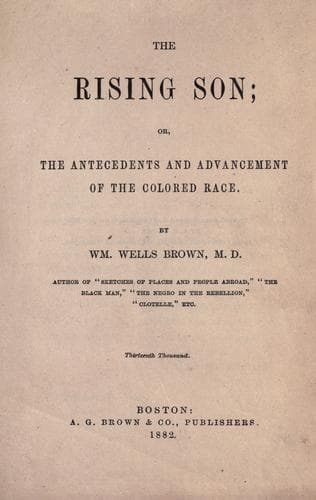
The Rising Son; or, the Antecedents and Advancement of the Colored RaceBrown, William Wells
History
The Rising Son; or, the Antecedents and Advancement of the Colored Race
Brown, William Wells
African Americans -- Biography; African Americans -- History; Black race; Slavery -- United States
Thomas Garrett was an Abolitionist from his youth up; and though the
grand old cause numbered among its supporters, poets, sages, and
statesmen, it had no more faithful worker in its ranks than Thomas
Garrett. The work of this good man lay in Delaware, one of the
meanest states in the Union, and the services which he rendered the
free colored people of that State in their efforts to rise above the
prejudice exhibited against their race can never be estimated.
But it was as a friend of the bondman escaping from his oppressor that
Mr. Garrett was most widely known. For more than forty years he devoted
himself to aiding the runaway slave in getting his freedom.
We have written of the executive officers of the most radical wing
of the Anti-slavery movement, yet there was still another band whose
labors were, if possible, more arduous, and deserve as much praise as
any of whom we have made mention.
These were the lecturing agents, the men and women who performed the
field service, the most difficult part of all the work. They went from
city to city, and from town to town, urging the claims of the slave to
his freedom; uttering truths that the people were not prepared for, and
receiving in return, rotten eggs, sticks, stones, and the condemnation
of the public generally. Many of these laborers neither asked nor
received any compensation; some gave their time and paid their own
expenses, satisfied with having an opportunity to work for humanity.
In the front rank of this heroic and fearless band, stood Abby Kelly
Foster, the Joan of Arc, of the anti-slavery movement. Born, we
believe, in the Society of Friends, and retaining to a great extent the
seriousness of early training, convinced of the heinousness of slavery,
she threw comfort, ease, and everything aside, and gave herself, in the
bloom of young womanhood, to the advocacy of the right of the negro to
his freedom. We first met Mrs. Foster (then Miss Kelly), about thirty
years ago, at Buffalo, in the State of New York, and for the first time
listened to a lecture against the hated system from which we had so
recently escaped.
Somewhat above the common height, slim, but well-proportioned,
finely-developed forehead and a pleasing countenance, eyes bright,
voice clear, gestures a little nervous, and dressed in a plain manner,
Mrs. Foster’s appearance on that occasion made a deep and lasting
impression upon her audience. The life-like pictures which she drew of
the helpless condition of her sisters in chains brought tears to many
eyes, and when she demanded that those chains should be broken they
responded with wild applause.
Public-domain text, read in full here on John Shaqi.
Reviews
Reviews
No reviews yet
Be the first to share your thoughts on this work.
Elsewhere in the archive
Join the Discussion
Join the discussion
Sign in to leave a comment or review.
Sign InorCreate an account