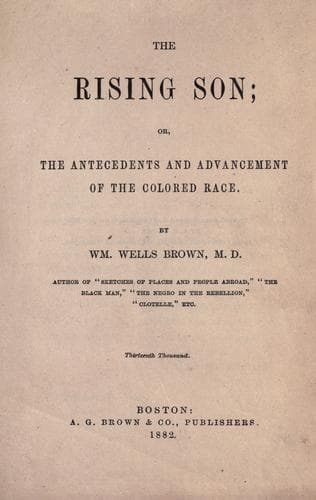
The Rising Son; or, the Antecedents and Advancement of the Colored RaceBrown, William Wells
History
The Rising Son; or, the Antecedents and Advancement of the Colored Race
Brown, William Wells
African Americans -- Biography; African Americans -- History; Black race; Slavery -- United States
Oliver Johnson gave his young manhood to the negro’s cause when to
be an Abolitionist cost more than words. He was, in the earlier days
of the movement, one of the hardest workers; both as a lecturer and
writer, that the cause had. Mr. Johnson is a cogent reasoner, a deep
thinker, a ready debater, an accomplished writer, and an eloquent
speaker. He has at times edited the “Herald of Freedom,” “Anti-Slavery
Standard,” and “Anti-Slavery Bugle;” and has at all times been one of
the most uncompromising and reliable of the “Old Guard.”
Henry C. Wright was also among the early adherents to the doctrine of
universal and immediate emancipation, and gave the cause the best years
of his life.
Giles B. Stebbins, a ripe scholar, an acute thinker, earnest and able
as a speaker, devoted to what he conceives to be right, was for years
one of the most untiring of freedom’s advocates.
Of those who occasionally volunteered their services without money and
without price, few struck harder blows at the old Bastile of slavery
than James N. Buffum, a man of the people, whose abilities have been
appreciated and acknowledged by his election as mayor of his own city
of Lynn.
James Miller McKim was one of the signers of the Declaration of
Sentiments, at Philadelphia, in 1833, and ever after gave his heart
and his labors to the slave’s cause. For many years the leading man
in the Anti-slavery Society in Pennsylvania, Mr. McKim’s labors were
arduous, yet he never swerved from duty. He is a scholar, well
read, and is a good speaker, only a little nervous. His round face
indicates perseverance that will not falter, and integrity that will
not disappoint. He always enjoyed the confidence of the Abolitionists
throughout the country, and is regarded as a man of high moral
character. Of the underground railroad through Pennsylvania, Mr. McKim
knows more than any man except William Still.
Mary Grew, for her earnest labors, untiring activity, and truly
eloquent speeches, was listened to with great interest and attention
wherever she spoke. A more zealous and able friend the slave never had
in Pennsylvania.
Lucretia Mott, the most eloquent woman that America ever produced,
was a life-long Abolitionist, of the straightest kind. For years her
clothing, food, and even the paper that she wrote her letters on, were
the products of free labor. Thirty years ago we saw Mrs. Mott take from
her pocket a little paper bag filled with sugar, and sweeten her tea.
We then learned that it was her practice so to do when travelling, to
be sure of having free sugar.
A phrenologist would pronounce her head faultless. She has a thoughtful
countenance, eyes beaming with intelligence, and a voice of much
compass. Mrs. Mott speaks hesitatingly at times, when she begins her
remarks, and then words flow easily, and every word has a thought. She
was always a favorite with the Abolitionists, and a welcome speaker at
their anniversary meetings.
Public-domain text, read in full here on John Shaqi.
Reviews
Reviews
No reviews yet
Be the first to share your thoughts on this work.
Elsewhere in the archive
Join the Discussion
Join the discussion
Sign in to leave a comment or review.
Sign InorCreate an account