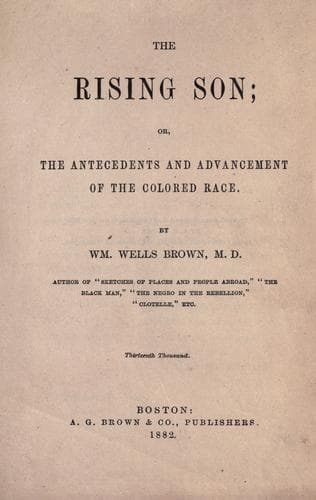
The Rising Son; or, the Antecedents and Advancement of the Colored RaceBrown, William Wells
History
The Rising Son; or, the Antecedents and Advancement of the Colored Race
Brown, William Wells
African Americans -- Biography; African Americans -- History; Black race; Slavery -- United States
This was the radical wing of the Abolitionists,--men and women who
believed mainly in moral suasion. Outside of these were many others
who were equally sincere, and were laboring with all their powers
to bring about emancipation, and to some of them I shall now call
attention.
Some thirty years ago we met for the first time a gentleman of noble
personal appearance, being about six feet in height, well-proportioned;
forehead high and broad; large dark eyes, full of expression; hair
brown, and a little tinged with gray. The fascination of his smiling
gaze, and the hearty shake of his large, soft hand, made us feel at
home when we were introduced to Gerrit Smith. His comprehensive and
well-cultivated mind, his dignified and deliberate manner and musical
voice fit him for what he is,--one of Nature’s noblest orators.
Speaking is not the finest trait in the character of Mr. Smith, but his
great, large heart, every pulsation of which beats for humanity. He
brought to the negro’s cause wealth and position, and laid it all upon
the altar of his redemption. In the year 1846 he gave three thousand
farms to the same number of colored men; and three years later he gave
a farm each to one thousand white men, with ten thousand dollars to be
divided amongst them.
Mr. Smith has spent in various ways many hundred thousand dollars
for the liberation and elevation of the blacks of this country. Next
to Mr. Smith, in the State of New York, is Beriah Greene, whose long
devotion to the cause of freedom is known throughout our land. Many of
the colored men whose career have done honor to the race, owe their
education to Mr. Greene. He is the most radical churchman we know of,
always right on the question of slavery. He did much in the early days
of the agitation, and his speeches were considered amongst the finest
productions on the anti-slavery platform.
The old Abolitionists of thirty years ago still remember with pleasure
the smiling face and intellectual countenance of Nathaniel P. Rogers,
editor of the “Herald of Freedom,” a weekly newspaper that found a
welcome wherever it went. Mr. Rogers was a man of rare gifts, of a
philosophical and penetrating mind, high literary cultivation, quick
perception, and of a most genial nature. He dealt hard blows at the
peculiar institution with both his tongue and his pen. As a speaker,
he was more argumentative than eloquent, but was always good in a
discussion. As an ardent friend of Mr. Garrison, and a co-worker with
him, Mr. Rogers should have been named with the moral suasionists.
William Goodell, a prolific writer, a deep thinker, a man of great
industry, and whose large eyes indicate immense language, has labored
long and faithfully for justice and humanity.
Public-domain text, read in full here on John Shaqi.
Reviews
Reviews
No reviews yet
Be the first to share your thoughts on this work.
Elsewhere in the archive
Join the Discussion
Join the discussion
Sign in to leave a comment or review.
Sign InorCreate an account