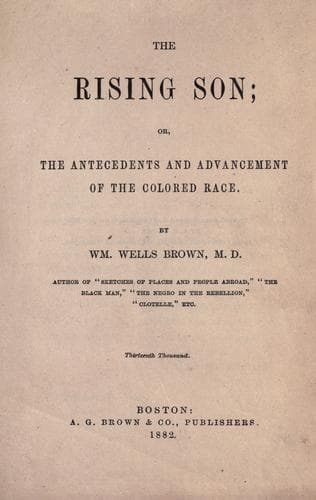
The Rising Son; or, the Antecedents and Advancement of the Colored RaceBrown, William Wells
History
The Rising Son; or, the Antecedents and Advancement of the Colored Race
Brown, William Wells
African Americans -- Biography; African Americans -- History; Black race; Slavery -- United States
The close of the Rebellion opened to the negro a new era in his
history. The chains of slavery had been severed; and although he had
not been clothed with all the powers of the citizen, the black man was,
nevertheless, sure of all his rights being granted, for revolutions
seldom go backward. With the beginning of the work of reconstruction,
the right of the negro to the ballot came legitimately before the
country, and brought with it all the virus of negro hate that could be
thought of. President Andrew Johnson threw the weight of his official
influence into the scales against the newly-liberated people, which
for a time cast a dark shadow over the cause of justice and freedom.
Congress, however, by its Constitutional amendments, settled the
question, and clothed the blacks with the powers of citizenship; and
with their white fellow-citizens they entered the reconstruction
conventions, and commenced the work of bringing their states back into
the Union. This was a trying position for the recently enfranchised
blacks; for slavery had bequeathed to them nothing but poverty,
ignorance, and dependence upon their former owners for employment and
the means of sustaining themselves and their families. The transition
through which they passed during the war, had imparted to some a
smattering of education; and this, with the natural aptitude of the
negro for acquiring, made the colored men appear to advantage in
whatever position they were called to take part.
The speeches delivered by some of these men in the conventions and
state legislatures exhibit a depth of thought, flights of eloquence,
and civilized statesmanship, that throw their former masters far in the
background.
In the work of reconstruction, the colored men had the advantage
of being honest and sincere in what they undertook, and labored
industriously for the good of the country.
The riots in various Southern states, following the enfranchising of
the men of color, attest the deep-rooted prejudice existing with the
men who once so misruled the rebellious states. In Georgia, Tennessee,
and Louisiana, these outbursts of ill feeling caused the loss of many
lives, and the destruction of much property. No true Union man, white
or black, was safe. The Constitutional amendment, which gave the ballot
to the black men of the North in common with their brethren of the
South, aroused the old pro-slavery feeling in the free states, which
made it scarcely safe for the newly enfranchised to venture to the
polls on the day of election in some of the Northern cities. The cry
that this was a “white man’s government,” was raised from one end of
the country to the other by the Democratic press, and the Taney theory
that “black men had no rights that white men were bound to respect,”
was revived, with all its negro hate.
Public-domain text, read in full here on John Shaqi.
Reviews
Reviews
No reviews yet
Be the first to share your thoughts on this work.
Elsewhere in the archive
Join the Discussion
Join the discussion
Sign in to leave a comment or review.
Sign InorCreate an account