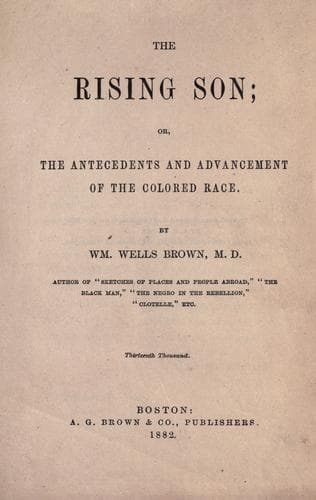
The Rising Son; or, the Antecedents and Advancement of the Colored RaceBrown, William Wells
History
The Rising Son; or, the Antecedents and Advancement of the Colored Race
Brown, William Wells
African Americans -- Biography; African Americans -- History; Black race; Slavery -- United States
Military occupation of the South was all that saved the freedmen
from destruction. Under it, they were able to take part in the
various Constitutional and Legislative elections, and to hold seats
in those bodies. As South Carolina had been the most conspicuous in
the Rebellion, so she was the first to return to the Union, and to
recognize the political equality of the race whom in former days she
had bought and sold. Her Senate hall, designed to echo the eloquence
of the Calhouns, the McDuffies, the Hammonds, the Hamptons, and the
Rhetts, has since resounded with the speeches of men who were once her
bond slaves. Ransier, the negro, now fills the chair of President of
the Senate, where once sat the proud and haughty Calhoun; while Nash,
the tall, gaunt, full-blooded negro, speaks in the plantation dialect
from the desk in which Wade Hampton in former days stood. The State
is represented in Congress by Elliott, Rainey, and De Large. South
Carolina submitted quietly to her destiny.
Not so, however, with Georgia. At the election in November, 1867,
for members to the State Convention, thirty thousand white and
eighty thousand colored votes were polled, and a number of colored
delegates elected. A Constitution was framed and ratified, and a
Legislature elected under it was convened. After all this, supposing
they had passed beyond Congressional control, the Rebel element in
the Legislature asserted itself; and many of those whose disabilities
had been removed by the State Convention, which comprised a number of
colored members, joined in the declaration which was made by that
Legislature, that a man having more than one-eighth of African blood in
his veins was ineligible to office.
These very men to whom the Republican party extended all the rights
and privileges of citizenship, of which they had deprived themselves,
denied political equality to a large majority of their fellow-citizens.
Twenty-eight members were expelled on December 22, 1869; an Act of
Congress was passed requiring the re-assembling of the persons declared
elected by the military commander, the restoration of the expelled
members, and the rejection of others, who were disqualified.
The expulsion of the ex-rebels from the Georgia Legislature, and the
admission of the loyal colored men, whose seats had been forcibly
taken from them, had a good effect upon all the Southern States, for
it showed that the national administration was determined that justice
should be done.
The prompt admission of Hiram R. Revels to a seat in the United States
Senate from Mississippi, showed that progress was the watch-word of
the Republican party. The appointments of E. D. Bassett as Minister to
Hayti, and J. Milton Turner as Consul-General to Liberia, set at rest
all doubt with regard to the views of President Grant, and the negro’s
political equality.
Public-domain text, read in full here on John Shaqi.
Reviews
Reviews
No reviews yet
Be the first to share your thoughts on this work.
Elsewhere in the archive
Join the Discussion
Join the discussion
Sign in to leave a comment or review.
Sign InorCreate an account