The Rising Son; or, the Antecedents and Advancement of the Colored RaceBrown, William Wells
History
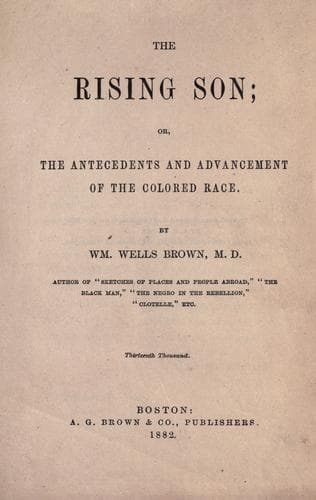
The Rising Son; or, the Antecedents and Advancement of the Colored Race
Brown, William Wells
African Americans -- Biography; African Americans -- History; Black race; Slavery -- United States
Stones and sticks, with which the populace were armed, were freely
used, to the great discomfiture of the English soldiers. “Don’t
hesitate! come on! We’ll drive these rebels out of Boston!” were the
last words heard from the lips of the colored man, for the sharp crack
of muskets silenced his voice, and he fell weltering in his blood.
Two balls had pierced his sable breast. Thus died Crispus Attucks, the
first martyr to American liberty, and the inaugurator of the revolution
that was destined to take from the crown of George the Third its
brightest star. An immense concourse of citizens followed the remains
of the hero to its last resting-place, and his name was honorably
mentioned in the best circles. The last words, the daring, and the
death of Attucks gave spirit and enthusiasm to the revolution, and his
heroism was imitated by both whites and blacks. His name was a rallying
cry for the brave colored men who fought at the battle of Bunker’s
Hill. In the gallant defence of Redbank, where four hundred blacks
met and defeated fifteen hundred Hessians, headed by Count Donop, the
thought of Attucks filled them with ardor. When Colonel Green fell at
Groton, surrounded by his black troops who perished with him, they went
into the battle feeling proud of the opportunity of imitating the first
martyr of the American revolution.
No monument has yet been erected to him. An effort was made in the
legislature of Massachusetts a few years since, but without success.
Five generations of accumulated prejudice against the negro had
excluded from the American mind all inclination to do justice to one of
her bravest sons. Now that slavery is abolished, we may hope, in future
years, to see a monument raised to commemorate the heroism of Crispus
Attucks.
PHILLIS WHEATLEY.
In the year 1761, when Boston had her slave market, and the descendants
of the Pilgrims appeared to be the most pious and God-fearing people
in the world, Mrs. John Wheatley went into the market one day, for
the purpose of selecting and purchasing a girl for her own use. Among
the group of children just imported from the African coast was a
delicately-built, rather good-looking child of seven or eight years,
apparently suffering from the recent sea-voyage and change of climate.
Mrs. Wheatley’s heart was touched at the interesting countenance and
humble modesty of this little stranger. The lady bought the child, and
she was named Phillis. Struck with the slave’s uncommon brightness,
the mistress determined to teach her to read, which she did with no
difficulty. The child soon mastered the English language, with which
she was totally unacquainted when she landed upon the American shores.
Public-domain text, read in full here on John Shaqi.
Reviews
Reviews
No reviews yet
Be the first to share your thoughts on this work.
Elsewhere in the archive
Join the Discussion
Join the discussion
Sign in to leave a comment or review.
Sign InorCreate an account