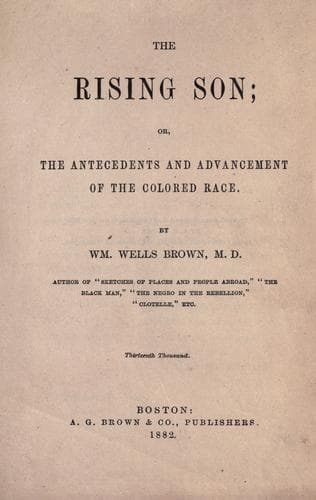
The Rising Son; or, the Antecedents and Advancement of the Colored RaceBrown, William Wells
History
The Rising Son; or, the Antecedents and Advancement of the Colored Race
Brown, William Wells
African Americans -- Biography; African Americans -- History; Black race; Slavery -- United States
Her school lessons were all perfect, and she drank in the Scriptural
teachings as if by intuition. At the age of twelve, she could write
letters and keep up a correspondence that would have done honor to one
double her years. Mrs. Wheatley, seeing her superior genius, no longer
regarded Phillis as a servant, but took her as a companion. It was
not surprising that the slave-girl should be an object of attraction,
astonishment, and attention with the refined and highly-cultivated
society that weekly assembled in the drawing-room of the Wheatleys.
As Phillis grew up to womanhood, her progress and attainments kept
pace with the promise of her earlier years. She drew around her the
best educated of the white ladies, and attracted the attention and
notice of the literary characters of Boston, who supplied her with
books, and encouraged the ripening of her intellectual powers. She
studied the Latin tongue, and translated one of Ovid’s tales, which was
no sooner put in print in America, than it was republished in London,
with elegant commendations from the reviews.
In 1773, a small volume of her poems, containing thirty-nine pieces,
was published in London, and dedicated to the Countess of Huntingdon.
The genuineness of this work was established in the first page of the
volume, by a document signed by the governor of Massachusetts, the
lieutenant-governor, her master, and fifteen of the most respectable
and influential citizens of Boston, who were acquainted with her
talents and the circumstances of her life. Her constitution being
naturally fragile, she was advised by her physician to take a sea
voyage, as the means of restoring her declining health.
Phillis was emancipated by her master at the age of twenty-one years,
and sailed for England. On her arrival, she was received and admired in
the first circles of London society; and it was at that time that her
poems were collected and published in a volume, with a portrait and a
memoir of the authoress. Phillis returned to America, and married Dr.
Peters, a man of her own color, and of considerable talents. Her health
began rapidly to decline, and she died at the age of twenty-six years,
in 1780. Fortunately rescued from the fate that awaits the victims of
the slave-trade, this injured daughter of Africa had an opportunity
of developing the genius that God had given her, and of showing to the
world the great wrong done to her race.
Although her writings are not free from imperfections of style and
sentiment, her verses are full of philosophy, beauty, and sublimity. It
cost her no effort to round a period handsomely, or polish a sentence
until it became transparent with splendor. She was easy, forcible, and
eloquent in language, and needed but health and a few more years of
experience to have made her a poet of greater note.
BENJAMIN BANNEKER.
Public-domain text, read in full here on John Shaqi.
Reviews
Reviews
No reviews yet
Be the first to share your thoughts on this work.
Elsewhere in the archive
Join the Discussion
Join the discussion
Sign in to leave a comment or review.
Sign InorCreate an account