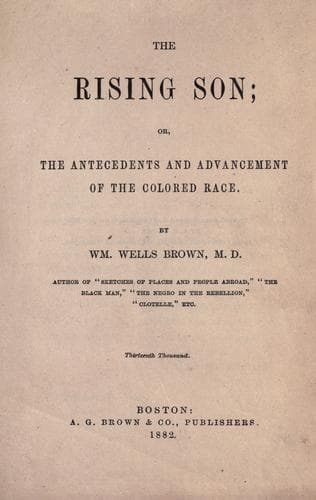
The Rising Son; or, the Antecedents and Advancement of the Colored RaceBrown, William Wells
History
The Rising Son; or, the Antecedents and Advancement of the Colored Race
Brown, William Wells
African Americans -- Biography; African Americans -- History; Black race; Slavery -- United States
The letter from Banneker, together with the almanac, created in the
heart of Mr. Jefferson a fresh feeling of enthusiasm in behalf of
freedom, and especially for the negro, which ceased only with his life.
The American statesman wrote to Brissot, the celebrated French writer,
in which he made enthusiastic mention of the “Negro Philosopher.” At
the formation of the “Society of the Friends of the Blacks,” at Paris,
by Lafayette, Brissot, Barnave, Condorcet, and Gregoire, the name of
Banneker was again and again referred to to prove the equality of the
races. Indeed, the genius of the “Negro Philosopher” did much towards
giving liberty to the people of St. Domingo. In the British House of
Commons, Pitt, Wilberforce, and Buxton often alluded to Banneker by
name, as a man fit to fill any position in society. At the setting off
of the District of Columbia for the capital of the federal government,
Banneker was invited by the Maryland commissioners, and took an
honorable part in the settlement of the territory. But, throughout
all his intercourse with men of influence, he never lost sight of the
condition of his race, and ever urged the emancipation and elevation
of the slave. He well knew that everything that was founded upon the
admitted inferiority of natural right in the African was calculated to
degrade him and bring him nearer to the foot of the oppressor, and he
therefore never failed to allude to the equality of the races when with
those whites whom he could influence. He always urged self-elevation
upon the colored people whom he met. He felt that to deprive the black
man of the inspiration of ambition, of hope, of wealth, of standing,
among his brethren of the earth, was to take from him all incentives to
mental improvement.
What husbandman incurs the toil of seed-time and culture, except with
a view to the subsequent enjoyment of a golden harvest? Banneker was
endowed by Nature with all those excellent qualifications which are
necessary previous to the accomplishment of a great man. His memory was
large and tenacious, yet, by a curious felicity, chiefly susceptible of
the finest impressions it received from the best authors he read, which
he always preserved in their primitive strength and amiable order. He
had a quickness of apprehension and a vivacity of understanding which
easily took in and surmounted the most subtile and knotty parts of
mathematics and metaphysics. He possessed in a large degree that genius
which constitutes a man of letters; that equality, without which,
judgment is cold, and knowledge is inert; that energy which collects,
combines, amplifies, and animates.
Public-domain text, read in full here on John Shaqi.
Reviews
Reviews
No reviews yet
Be the first to share your thoughts on this work.
Elsewhere in the archive
Join the Discussion
Join the discussion
Sign in to leave a comment or review.
Sign InorCreate an account