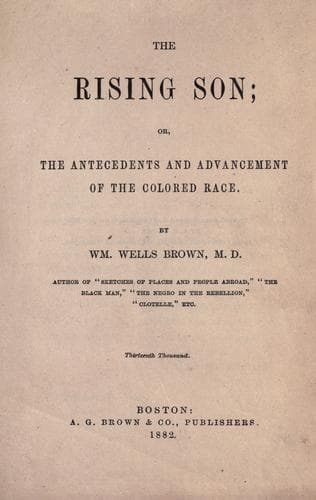
The Rising Son; or, the Antecedents and Advancement of the Colored RaceBrown, William Wells
History
The Rising Son; or, the Antecedents and Advancement of the Colored Race
Brown, William Wells
African Americans -- Biography; African Americans -- History; Black race; Slavery -- United States
He knew every branch of history, both natural and civil; he had read
all the original historians of England, France, and Germany, and
was a great antiquarian. Criticism, metaphysics, morals, politics,
voyages, and travels, were all studied and well digested by him. With
such a fund of knowledge, his conversation was equally interesting,
instructive, and entertaining. Banneker was so favorably appreciated
by the first families in Virginia, that in 1803 he was invited by
Mr. Jefferson, then President of the United States, to visit him at
Monticello, where the statesman had gone for recreation. But he was
too infirm to undertake the journey. He died the following year, aged
seventy-two. Like the golden sun that has sunk beneath the western
horizon, but still throws upon the world, which he sustained and
enlightened in his career, the reflected beams of his departed genius,
his name can only perish with his language.
Banneker believed in the divinity of reason, and in the omnipotence of
the human understanding, with Liberty for its handmaid. The intellect,
impregnated by science, and multiplied by time, it appeared to him,
must triumph necessarily over all the resistance of matter. He had
faith in liberty, truth, and virtue. His remains still rest in the
slave state where he lived and died, with no stone to mark the spot, or
tell that it is the grave of Benjamin Banneker. He labored incessantly,
lived irreproachably, and died in the literary harness, universally
esteemed and regretted.
WILLIAM P. QUINN.
The man who lays aside home comforts, and willingly becomes a
missionary to the poorest of the poor, deserves the highest praise
that his fellow-men can bestow upon him. After laboring faithfully for
the upbuilding of the church in New York, Baltimore, and Philadelphia,
William P. Quinn, thirty-five years ago, went to the West, a most
undesirable place for a colored man at that time. But he did not count
the cost; it was enough for him to know that his services were needed,
and he left the consequences with God.
Never, probably, was a man more imbued with the spirit of the Great
Teacher, than was Mr. Quinn in his missionary work. Old men and women
are still living who delight to dwell on the self-denial, Christian
zeal, manly graces, and industry that characterized this good man in
the discharge of his duties in Ohio, Indiana, Illinois, and Missouri.
His advice was always fatherly; his example inculcated devoted piety.
As a speaker, he was earnest and eloquent, possessing an inward
enthusiasm that sent a magnetic current through his entire
congregation. Having the fullest confidence of the people with whom
he was called to labor, they regarded him as one sent of God, and
they hung upon his words as if their future welfare depended upon the
counsel they received.
In 1844, Mr. Quinn was made a bishop, a position for which he had every
qualification. Tanner, in his “Apology,” says:--
Public-domain text, read in full here on John Shaqi.
Reviews
Reviews
No reviews yet
Be the first to share your thoughts on this work.
Elsewhere in the archive
Join the Discussion
Join the discussion
Sign in to leave a comment or review.
Sign InorCreate an account