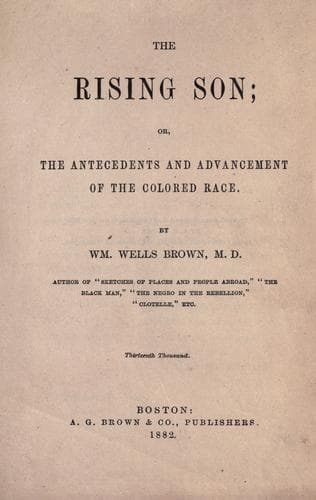
The Rising Son; or, the Antecedents and Advancement of the Colored RaceBrown, William Wells
History
The Rising Son; or, the Antecedents and Advancement of the Colored Race
Brown, William Wells
African Americans -- Biography; African Americans -- History; Black race; Slavery -- United States
The career of this distinguished individual whose name heads this
sketch, is more widely known than that of any other living colored
man. Born and brought up under the institution of slavery, which
denied its victims the right of developing those natural powers that
adorn the children of men, and distinguish them from the beasts of
the forest,--an institution that gave a premium to ignorance, and
made intelligence a crime, when the possessor was a negro,--Frederick
Douglass is, indeed, the most wonderful man that America has ever
produced, white or black.
His days of servitude were like those of his race who were born at the
South, differing but little from the old routine of plantation life.
Douglass, however, possessed superior natural gifts, which began to
show themselves even when a boy, but his history has become too well
known for us to dwell on it here. The narrative of his life, published
in 1845, gave a new impetus to the black man’s literature. All other
stories of fugitive slaves faded away before the beautifully-written,
highly-descriptive, and thrilling memoir of Frederick Douglass. Other
narratives had only brought before the public a few heart-rending
scenes connected with the person described. But Mr. Douglass, in his
book, brought not only his old master’s farm and its occupants before
the reader, but the entire country around him, including Baltimore
and its shipyard. The manner in which he obtained his education,
and especially his learning to write, has been read and re-read by
thousands in both hemispheres. His escape from slavery is too well
understood to need a recapitulation here.
He took up his residence in New Bedford, where he still continued the
assiduous student, mastering the different branches of education which
the accursed institution had deprived him of in early life.
His advent as a lecturer was a remarkable one. White men and black men
had talked against slavery, but none had ever spoken like Frederick
Douglass. Throughout the North the newspapers were filled with the
sayings of the “eloquent fugitive.” He often travelled with others, but
they were all lost sight of in the eagerness to hear Douglass. His
travelling companions would sometimes get angry, and would speak first
at the meetings; then they would take the last turn; but it was all
the same--the fugitive’s impression was the one left upon the mind. He
made more persons angry, and pleased more, than any other man. He was
praised, and he was censured. He made them laugh, he made them weep,
and he made them swear.
Public-domain text, read in full here on John Shaqi.
Reviews
Reviews
No reviews yet
Be the first to share your thoughts on this work.
Elsewhere in the archive
Join the Discussion
Join the discussion
Sign in to leave a comment or review.
Sign InorCreate an account