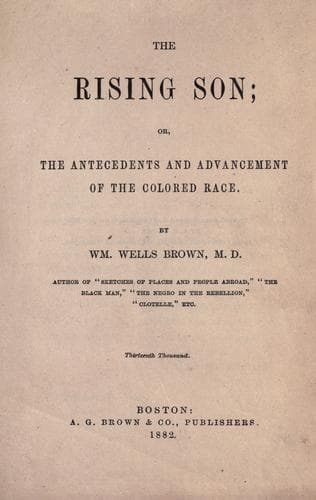
The Rising Son; or, the Antecedents and Advancement of the Colored RaceBrown, William Wells
History
The Rising Son; or, the Antecedents and Advancement of the Colored Race
Brown, William Wells
African Americans -- Biography; African Americans -- History; Black race; Slavery -- United States
“The demands of the work made it necessary to elect another bishop,
and, as if by inspiration, a large majority fixed their eyes on the
great missionary as the man most competent to fill the post.”
Bishop Quinn died in February, 1873, at the advanced age of eighty-five
years.
DAVID RUGGLES.
Of those who took part in the anti-slavery work thirty-five years ago,
none was more true to his race than David Ruggles. Residing in the city
of New York, where slaveholders often brought their body servants, and
kept them for weeks, Mr. Ruggles became a thorn in the sides of these
Southern sinners. He was ready at all times, in dangers and perils,
to wrest his brethren from these hyenas, and so successful was he in
getting slaves from their masters, and sending them to Canada, that he
became the terror of Southerners visiting northern cities. He was one
of the founders of the celebrated underground railroad.
Harassed by the pro-slavery whites, and betrayed and deserted by some
of his own color, David Ruggles still labored for his people.
He was deeply interested in the moral, social, and political elevation
of the free colored men of the North, and to that end published and
edited for several years the “Mirror of Liberty,” a quarterly magazine,
devoted to the advocacy of the rights of his race.
As a writer, Mr. Ruggles was keen and witty,--always logical,--sending
his arrows directly at his opponent. The first thing we ever read,
coming from the pen of a colored man, was “David M. Reese, M. D.,
used up by David Ruggles, a man of color.” Dr. Reese was a noted
colonizationist, and had written a work in which he advocated the
expatriation of the blacks from the American continent; and Mr.
Ruggles’s work was in reply to it. In this argument the negro proved
too much for the Anglo-Saxon, and exhibited in Mr. Ruggles those
qualities of keen perception, deep thought, and originality, that mark
the critic and man of letters.
He was of unmixed blood, of medium size, genteel address, and
interesting in conversation.
Attacked with a disease which resulted in total blindness, Mr. Ruggles
visited Northampton, Massachusetts, for the benefit of his health. Here
he founded a “Water Cure,” which became famous, and to which a large
number of the better classes resorted. In this new field, Mr. Ruggles
won honorable distinction as a most successful practitioner, secured
the warm regard of the public, and left a name embalmed in the hearts
of many who feel that they owe life to his eminent skill and careful
practice. Mr. Ruggles was conscientious, upright, and just in all his
dealings. He died in 1849, universally respected and esteemed.
FREDERICK DOUGLASS.
Public-domain text, read in full here on John Shaqi.
Reviews
Reviews
No reviews yet
Be the first to share your thoughts on this work.
Elsewhere in the archive
Join the Discussion
Join the discussion
Sign in to leave a comment or review.
Sign InorCreate an account