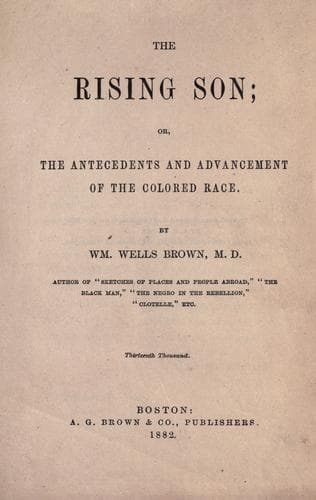
The Rising Son; or, the Antecedents and Advancement of the Colored RaceBrown, William Wells
History
The Rising Son; or, the Antecedents and Advancement of the Colored Race
Brown, William Wells
African Americans -- Biography; African Americans -- History; Black race; Slavery -- United States
Among the fine-looking men that have been sent out by the A. M. E.
Church, to preach the gospel, none has a more manly frame, intellectual
countenance, gentlemanly demeanor, Christian spirit, and love of his
race, than John M. Brown. When the Committee on Boundary in the A. M.
E. Church recommended in the General Conference of 1864, “that there be
set apart a Conference in the State of Louisiana, to be known as the
Louisiana Conference, embracing the States of Louisiana, Mississippi,
Arkansas, Alabama, Texas, and all that part of Florida lying west of
Chattanooga River,” Mr. Brown was selected as the man eminently fitted
to go to the new field of labor. Money was evidently not a burden to
him, for, being a barber, he got on a steamer, and shaved his way to
his post of labor.[54]
He arrived in New Orleans, unfurled his banner, and went to work in a
way that showed that he was “terribly in earnest.” He sowed the seed,
and, although he was thrown into the calaboose, his work still went
on, a church was erected, members were gathered in, and the cause
of Christian missions prospered. After laboring faithfully in this
field, Mr. Brown was appointed Corresponding Secretary of the A. M. E.
Church, with his head-quarters in Baltimore. He now holds the high and
honorable position of bishop, a place that no one is better qualified
to fill than he.
He is a mulatto, of middle age, with talents of a high order, fluent
speaker, terse writer, and popular with all classes. Oberlin College
has not turned out a more praiseworthy scholar, nor a better specimen
of a Christian gentleman, than Bishop Brown.
JOHN I. GAINES.
Mr. Gaines was born at Cincinnati, Ohio, November 6th, 1821. His early
education was limited, as was generally the case with colored youth in
that section, in those days. Forced into active life at an early age,
he yet found time to make himself a fair English scholar, and laid the
foundation of that power to be useful, which he afterwards exercised
for the benefit of his people.
At the age of sixteen, he was found in attendance upon a convention,
held in one of the interior towns of his native state. At that early
age, he showed clearly his mental powers, and men, many years his
senior listened with respect to the sage counsel which even then he
was capable of giving. From that time to the very day of his death he
mingled in the councils, and busied himself with the affairs of his
people; and it is no derogation to the merits of others to say, that
few have counselled more wisely, or acted more successfully than he.
Public-domain text, read in full here on John Shaqi.
Reviews
Reviews
No reviews yet
Be the first to share your thoughts on this work.
Elsewhere in the archive
Join the Discussion
Join the discussion
Sign in to leave a comment or review.
Sign InorCreate an account