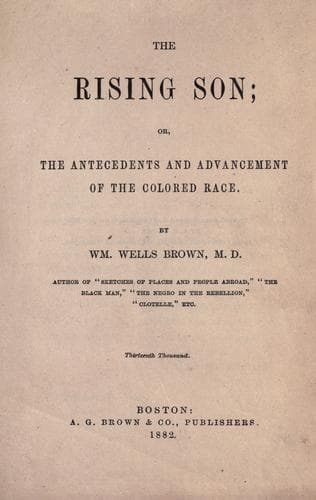
The Rising Son; or, the Antecedents and Advancement of the Colored RaceBrown, William Wells
History
The Rising Son; or, the Antecedents and Advancement of the Colored Race
Brown, William Wells
African Americans -- Biography; African Americans -- History; Black race; Slavery -- United States
The enterprise with which his name is the most permanently connected,
is the movement which has given to Cincinnati her system of public
schools for colored youth. When the law of 1849, granting school
privileges to colored youth, was passed, the City Council of
Cincinnati refused to appropriate the funds placed in the treasury for
the support of the schools, alleging that there was no authority to do
so. Here was a chance for our deceased friend to exhibit those high
qualities which made him a lamp to the feet of his people. Cautious,
but firm, determined, but patient, he led in the movement, which
resulted in a decision of the Supreme Court of the State, placing
the colored public schools upon the same footing as the other public
schools of the city, and gave their control to a board of directors
selected by the colored people. The contest was prolonged nearly two
years, but at last the little black man triumphed over the city of
Cincinnati.
His next aim was to have the schools thoroughly organized, and placed
in comfortable houses. He cheerfully performed the onerous duties
of clerk and general agent to the Board, his only reward being a
consciousness that he was useful to his people. His purposes were
temporarily interrupted in 1853, by a law taking the control of the
schools from the colored people. Not connected officially with the
schools, he still maintained a deep interest in their condition, and,
in 1856, an opportunity offering, he used his influence and means
to have the schools again placed under the control of the colored
people. This point gained, he again set on foot measures looking to
the erection of school-houses. This he at last accomplished. His
first report to the City Council, made in 1851, urges the erection
of school-houses, and his last report, made in 1859, announces the
completion of two large houses, costing over twenty-four thousand
dollars.
If he is a benefactor of his race, who causes two blades of grass to
grow where but one grew before, surely, he is worthy of praise, who
has let rays of intellectual light fall upon the famished minds of a
forlorn race, whom a hard fate has condemned to slavery and ignorance.
He was, from early youth, a firm, though not fanatical adherent of
the Temperance cause. He felt that intoxicating drinks had caused
many strong men to fall, and, for his brother’s sake, he abstained.
Meeting one evening, at a social party, a gentleman from a neighboring
State, eminent in the world of politics and philanthropy, a bottle
of sparkling Catawba and two glasses were placed on the table before
them, the host remarking at the time that “there was no need for two
tumblers, for Mr. Gaines would not use his.”
“Surely, Mr. Gaines will pledge me, a friend of his race, in a glass
of wine made from the grape that grows on his native hills,” said the
gentleman.
Mr. Gaines shook his head. “I appreciate the honor,” said he, “but
conscience forbids.”
Public-domain text, read in full here on John Shaqi.
Reviews
Reviews
No reviews yet
Be the first to share your thoughts on this work.
Elsewhere in the archive
Join the Discussion
Join the discussion
Sign in to leave a comment or review.
Sign InorCreate an account