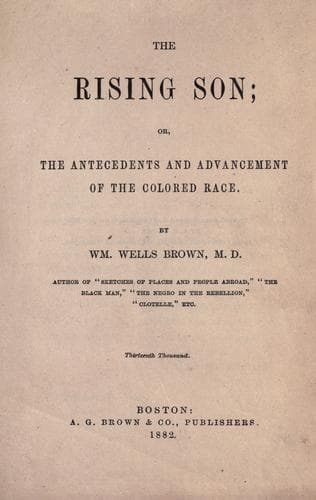
The Rising Son; or, the Antecedents and Advancement of the Colored RaceBrown, William Wells
History
The Rising Son; or, the Antecedents and Advancement of the Colored Race
Brown, William Wells
African Americans -- Biography; African Americans -- History; Black race; Slavery -- United States
“I, too, can make a stone man,” she said to herself; and at once she
went to visit William Lloyd Garrison, and told him what she knew she
could do, and asked him how she should set about doing it.
Struck by her enthusiasm, Garrison gave her a note of introduction to
Brackett, the Boston sculptor, and after a little talk with her, Mr.
Brackett gave her a piece of clay and a mould of a human foot, as a
study.
“Go home and make that,” said he; “if there is anything in you, it will
come out.”
Alone in her own room, the young girl toiled over her clay, and when
she had done her best, carried the result to her master. He looked
at her model, broke it up, and said, “Try again.” She did try again,
modelled feet and hands, and at last undertook a medallion of the head
of John Brown, which was pronounced excellent.
The next essay was the bust of a young hero, Colonel Shaw, the first
man who took the command of a colored regiment, and whose untimely and
glorious death, and the epitaph spoken by the South, “Bury him with his
niggers,” have made him an immortal name in the history of our civil
war.
The family of this young hero heard of the bust which the colored girl
was making as a labor of love, and came to see it, and were delighted
with the portrait which she had taken from a few poor photographs. Of
this bust she sold one hundred copies, and with that money she set out
for Europe, full of hope and courage.
Arriving at Rome, Miss Lewis took a studio, and devoted herself to hard
study and hard work, and here she made her first statue--a figure of
Hagar in her despair in the wilderness. It is a work full of feeling,
for, as she says, “I have a strong sympathy for all women who have
struggled and suffered. For this reason the Virgin Mary is very dear to
me.”
The first copy of Hagar was purchased by a gentleman from Chicago. A
fine group of the Madonna with the infant Christ in her arms, and two
adoring angels at her feet, attests the sincerity of her admiration
for the Jewish maiden. This last group has been purchased by the young
Marquis of Bute, Disraeli’s Lothair, for an altar-piece.
Among Miss Lewis’s other works are two small groups, illustrating
Longfellow’s poem of Hiawatha. Her first, “Hiawatha’s Wooing,”
represents Minnehaha seated, making a pair of moccasins, and Hiawatha
by her side, with a world of love-longing in his eyes. In the marriage,
they stand side by side with clasped hands. In both, the Indian
type of features is carefully preserved, and every detail of dress,
etc., is true to nature. The sentiment is equal to the execution.
They are charming hits, poetic, simple, and natural; and no happier
illustrations of Longfellow’s most original poem were ever made than
these by the Indian sculptor.
Public-domain text, read in full here on John Shaqi.
Reviews
Reviews
No reviews yet
Be the first to share your thoughts on this work.
Elsewhere in the archive
Join the Discussion
Join the discussion
Sign in to leave a comment or review.
Sign InorCreate an account