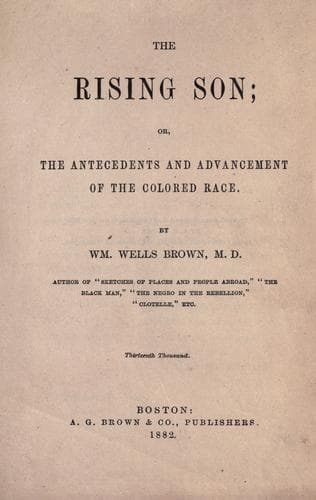
The Rising Son; or, the Antecedents and Advancement of the Colored RaceBrown, William Wells
History
The Rising Son; or, the Antecedents and Advancement of the Colored Race
Brown, William Wells
African Americans -- Biography; African Americans -- History; Black race; Slavery -- United States
A fine bust, also, of this same poet, is about to be put in marble,
which has been ordered by Harvard College; and in this instance, at
least, Harvard has done itself honor. If it will not yet open its doors
to women who ask education at its hands, it will admit the work of a
woman who has educated herself in her chosen department.
Miss Lewis has a fine medallion portrait of Wendell Phillips, a
charming group of sleeping babies, and some other minor works, in her
studio. At Rome, she is visited by strangers from all nations, who
happen in the great city, and every one admires the genius of the
artist.
The highest art is that which rises above the slavish copying of
nature, without sinking back again into a more slavish conventionalism.
All the forms of such art are intensely simple and natural, but through
the natural, the spiritual speaks. The saintly glory shines through
the features of its saints, and does not gather in a ring around their
heads. It speaks a language all can understand, and has no jargon of
its own. It needs no initiation before we can understand its mysteries,
excepting that of the pure heart and the awakened mind. It represents
nature, but in representing, it interprets her. It shows us nothing but
reality, but in the real, it mirrors the invisible ideal.
A statue is a realized emotion, or a thought in stone--not an embodied
dream. A picture is a painted poem--not a romance in oil. Working
together with nature, such art rises to something higher than nature
is, becomes the priestess of her temple, and represents to more prosaic
souls that which only the poet sees. The truly poetical mind of Edmonia
Lewis shows itself in all her works, and exhibits to the critic the
genius of the artist.
ROBERT PURVIS.
Robert Purvis was born in Charleston, South Carolina, but had the
advantages of a New England collegiate education. He early embraced
the principles of freedom as advocated by William Lloyd Garrison, and
during the whole course of the agitation of the question of slavery,
remained true to his early convictions.
Possessed of a large fortune at the very commencement of life, Mr.
Purvis took an active part in aiding slaves to obtain their freedom, by
furnishing means to secure for them something like justice before the
pro-slavery courts of Pennsylvania, when arrested as fugitives, or when
brought into the state voluntarily by their owners.
Mr. Purvis did not stop with merely giving of his abundant means, but
made many personal sacrifices, and ran risks of loss of life in doing
what he conceived to be an act of duty. Though white enough to pass as
one of the dominant race, he never denied his connection with the negro.
In personal appearance, and in manners, Mr. Purvis is every inch
the gentleman. Possessing a highly-cultivated mind, a reflective
imagination, easy and eloquent in speech, but temper quickly aroused,
he is always interesting as a public speaker.
Public-domain text, read in full here on John Shaqi.
Reviews
Reviews
No reviews yet
Be the first to share your thoughts on this work.
Elsewhere in the archive
Join the Discussion
Join the discussion
Sign in to leave a comment or review.
Sign InorCreate an account