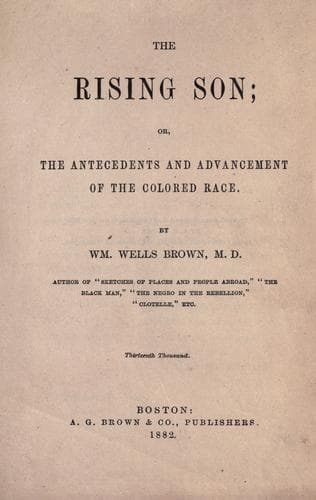
The Rising Son; or, the Antecedents and Advancement of the Colored RaceBrown, William Wells
History
The Rising Son; or, the Antecedents and Advancement of the Colored Race
Brown, William Wells
African Americans -- Biography; African Americans -- History; Black race; Slavery -- United States
Although he spent a large amount in philanthropic causes, Mr. Purvis is
still a man of wealth, and owns a princely residence at Bybury, some
fifteen miles from Philadelphia. With character unblemished, blameless
in his domestic life, an ardent friend, and a dangerous foe, Robert
Purvis stands to-day an honor to both races.
JAMES M. WHITFIELD.
James M. Whitfield was a native of Massachusetts, and removed in early
life to Buffalo, New York, where he followed the humble occupation
of a barber. However, even in this position, he became noted for his
scholarly attainments and gentlemanly deportment. Men of polish and
refinement were attracted to his saloon, and while being shaved, would
take pleasure in conversing with him; and all who knew him felt that he
was intended by Nature for a more elevated station in life.
He wrote some fine verses, and published a volume of poems in 1846,
which well stood the test of criticism. His poem, “How long, O God,
how long!” is a splendid production, and will take a place in American
literature.
Mr. Whitfield removed to California some years since, where he took a
forward stand with the progressive men of his race.
PHILLIP A. BELL.
Although we have but a meagre historical record, as producers of
books, magazines, and newspapers, it must still be admitted that some
noble efforts have been made, and not a little time and money spent by
colored men in literary enterprises during the last forty years. The
oldest, and one of the ablest of American journalists, is Phillip A.
Bell.
This gentleman started the “Colored American” in the year 1837, as
co-editor with the late Rev. Samuel E. Cornish, and subsequently, with
the late Dr. James M’Cune Smith. The paper was a weekly, and published
in the city of New York. The “Colored American” was well conducted,
had the confidence of the public, distinguished for the ability shown
in its editorials, as well as its correspondents.
Mr. Bell retired from the management of the paper, in 1840. All,
however, who remember as far back as thirty-five years, will bear
testimony to the efficient work done by the “Colored American,” and the
honor that is due to its noble founder. Some ten years ago, Mr. Bell
removed to California, where he, in company with Mr. Peter Anderson,
flung to the breeze the “Pacific Appeal,” a weekly newspaper, devoted
to the interest of the colored man, and which has accomplished great
good for humanity. In 1865, Mr. Bell launched the “Elevator,” a spicy
weekly, the columns of which attest its ability. Science, philosophy,
and the classics are treated in a masterly manner.
Mr. Bell is an original and subtile writer, has fine powers of
analysis, and often flings the sparkling rays of a vivid imagination
over the productions of his pen.
His articles are usually of a practical nature, always trying to remove
evils, working for the moral, social, and political elevation of his
race.
Public-domain text, read in full here on John Shaqi.
Reviews
Reviews
No reviews yet
Be the first to share your thoughts on this work.
Elsewhere in the archive
Join the Discussion
Join the discussion
Sign in to leave a comment or review.
Sign InorCreate an account