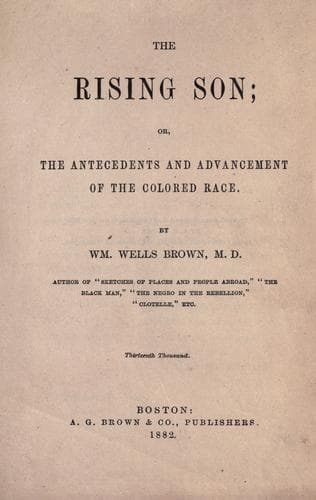
The Rising Son; or, the Antecedents and Advancement of the Colored RaceBrown, William Wells
History
The Rising Son; or, the Antecedents and Advancement of the Colored Race
Brown, William Wells
African Americans -- Biography; African Americans -- History; Black race; Slavery -- United States
No dominant religion was admitted; the liberty of worship was
proclaimed; the State was not to take on itself the support of any
religious institution. Marriage was declared a purely civil act, and in
some cases divorce was permitted. State offences were to be tried by
a council to be named by the Emperor. All property belonging to white
Frenchmen was confiscated to the State. The houses of the citizens were
pronounced inviolable.
The Constitution was placed under the safeguard of the magistrates, of
fathers, of mothers, of citizens, of soldiers, and recommended to their
descendants, to all the friends of liberty, to the philanthropists of
all countries, as a striking token of the goodness of God, who, in the
order of his immortal decrees, had given the Haytians power to break
their bonds, and make themselves a free, civilized, and independent
people. This Constitution, which, considering its origin, contains so
much that is excellent, and which even the long civilized States of
Europe might advantageously study, was accepted by the emperor, and
ordered to be forthwith carried into execution.
The condition of the farm-laborer was the same as under the system
of Toussaint L’Ouverture; he labored for wages which were fixed at
one-fourth of the produce, and that produce was abundant. The whip and
all corporal punishments were abolished.
Idleness was regarded as a crime, but was punished only by
imprisonment. Two-thirds of the labor extracted under slavery was
the amount required under the new system. Thus the laborers gained
a diminution of one-third of their toil, while their wants were
amply supplied. The mulattoes, or quaterons, children of whites and
mulattoes, who were very numerous, if they could show any relationship,
whether legitimate or not, with the old white proprietors, were allowed
to inherit their property.
Education was not neglected in the midst of these outward and material
arrangements. In nearly all the districts, schools were established;
and the people, seeing what advantage was to be derived from learning,
entered them, and plied themselves vigorously to gain in freedom what
they had lost in slavery.
A praiseworthy effort was made by the framers of the constitution,
under which Dessalines was inaugurated emperor, to extinguish all
distinctions of color among the colored people themselves.
They decreed that the people should be denominated _blacks_; but such
distinctions are far stronger than words on paper. Unfortunately,
the distinctions in question, which was deeply rooted, and rested
on prejudices and antipathies which will never be erased from human
nature, had been aggravated by long and sanguinary contests between the
blacks and mulattoes.
Public-domain text, read in full here on John Shaqi.
Reviews
Reviews
No reviews yet
Be the first to share your thoughts on this work.
Elsewhere in the archive
Join the Discussion
Join the discussion
Sign in to leave a comment or review.
Sign InorCreate an account