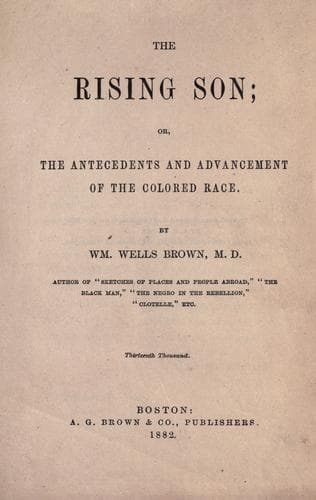
The Rising Son; or, the Antecedents and Advancement of the Colored RaceBrown, William Wells
History
The Rising Son; or, the Antecedents and Advancement of the Colored Race
Brown, William Wells
African Americans -- Biography; African Americans -- History; Black race; Slavery -- United States
Aware of that individual superiority which springs from a share in
the influences of civilization, the mulattoes of Hayti despised the
uneducated black laborers by whom they were surrounded, and felt that
by submitting to their sway, they put themselves under the domination
of a majority whose sole authority lay exclusively in their numbers.
The mulattoes really believed that their natural position was to fill
the places in the government once held by the whites.
They would no doubt have forgotten their party interests, and labored
for the diffusion through the great body of the people of the higher
influence of civilization, if they could have secured those positions.
The mutual hatred between the mulattoes and the blacks was so deeply
rooted, that neither party could see anything good in the other;
and therefore, whatever was put forth by one party, no matter how
meritorious in itself, was regarded with suspicion by the other.
The regular army of Dessalines was composed of fifteen thousand men,
in which there was included a corps of fifteen hundred cavalry. They
were a motley assemblage of ragged blacks, kept in the ranks, and
performing their limited routine of duty through the awe inspired among
them by the rigid severity of the imperial discipline. The uniform
of the troops had not been changed when the Island was erected into
an independent power, and the red and blue of the French army still
continued to distinguish the soldiers of the Haytian army, even when
the French were execrated as a race of monsters, with whom the blacks
of St. Domingo should have nothing in common. Together with the regular
army of the empire, there existed a numerous corps of national guard,
composed of all who were capable of bearing arms; though the services
of these were not required but in some dangerous emergency of the
State. The national guard and regular army were called into the field
four times every year; and during these seasons of military movement,
the government of Dessalines was over a nation of soldiers in arms, as
they remained in their encampment for some days, to be instructed in
military knowledge, and to be reviewed by the great officers of the
empire.
Dessalines now put forth a proclamation filled with accusations against
the white French still on the Island.
This ferocious manifesto was intended as a preliminary measure in the
train of horrible events to follow. In the month of February, 1805,
orders were issued for the pursuit and arrest of all those Frenchmen
who had been accused of being accomplices in the executions ordered by
Rochambeau.
Public-domain text, read in full here on John Shaqi.
Reviews
Reviews
No reviews yet
Be the first to share your thoughts on this work.
Elsewhere in the archive
Join the Discussion
Join the discussion
Sign in to leave a comment or review.
Sign InorCreate an account